















Quick Answer
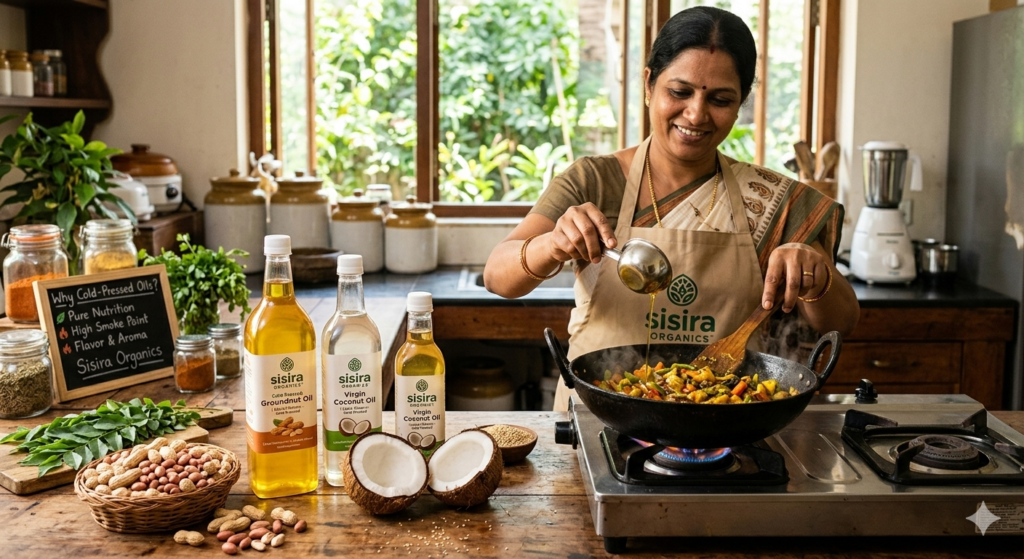
We use cold pressed oils for cooking because they preserve the complete nutritional profile of the original seed — Vitamin E, polyphenols, phytosterols, and healthy fatty acids — that are destroyed during high-heat chemical refining. Extracted mechanically at below 45°C with no solvents or additives, cold pressed oils deliver genuine nourishment with every meal, authentic flavour that transforms dishes, and zero chemical residues. A 2024 study confirmed cold pressed oils retain up to 90% of natural Vitamin E compared to less than 30% in refined oils — and according to India’s National Institute of Nutrition (2025), switching to cold pressed oil can reduce LDL cholesterol by 10–12% in just eight weeks.
Every meal you cook begins with a choice that most people make without thinking: which oil goes in the pan. It is one of the most repeated decisions in your daily routine – and one of the least examined. The bottle gets opened, the oil gets poured, and the cooking begins. But the type of oil you choose does far more than prevent food from sticking to the pan. It determines what nutrients your family’s bodies receive at every meal, what harmful compounds they may or may not be exposed to, and whether the food you cook tastes like it genuinely should.
The shift toward cold pressed oils for cooking that is happening across Indian households right now is not a passing trend. It is a scientifically grounded return to something that Indian culinary tradition never should have abandoned – the genuine, unprocessed, chemically intact oil that our grandmothers used without a second thought, and that modern nutritional research is now confirming was better in almost every measurable way.
In this complete guide, we answer the question that more and more health-conscious Indian cooks are asking: why do we use cold pressed oils for cooking? The answer goes deeper than most people realise — and it will change the way you think about every oil bottle in your kitchen.

Table of Contents
- What is Cold Pressed Oil — and How is it Made?
- What Happens Inside a Refined Oil Factory
- 10 Science-Backed Reasons to Use Cold Pressed Oil for Cooking
- Nutrient Comparison: Cold Pressed vs Refined Oil
- Which Cold Pressed Oil for Which Cooking Method?
- How to Use Cold Pressed Oils Correctly in Indian Cooking
- Sisira Organics — Traditionally Extracted, Genuinely Pure
- Frequently Asked Questions
What is Cold Pressed Oil — and How is it Made?
Cold pressed oil is produced by feeding raw, cleaned oil seeds or nuts into a mechanical press — traditionally a wooden device called the chekku (Tamil Nadu, Karnataka), ghani (North India), or Lakdi Ghani — where a slowly rotating wooden pestle crushes the seeds under steady pressure, releasing their oil naturally. The critical distinction is temperature: throughout the entire extraction process, the oil never exceeds 40–50°C. No external heat is applied. No chemical solvents are used. Nothing is added to the oil before, during, or after extraction.
This matters enormously because oil is not simply fat. It is a complex biological liquid containing dozens of heat-sensitive compounds — antioxidant vitamins, protective polyphenols, cholesterol-modulating phytosterols, and the precise balance of fatty acids that makes each seed’s oil uniquely beneficial. All of these compounds evolved to survive in the seed. None of them evolved to survive temperatures above 100°C, exposure to petroleum-derived solvents, or bleaching with activated clay.
What science confirms: A 2025 study published in Frontiers in Nutrition (USDA, Agriculture Research Service) found that cold pressing of oilseeds without further refinement “preserves minor lipid components — phytosterols and Vitamin E are retained — along with small volatile and semi-volatile compounds that provide distinct and pleasing flavours and aromas.” The study confirmed these cold pressed oils are “healthier choices than refined vegetable oils.” A separate 2025 study in Scientific Reports (Nature Publishing Group) evaluating nine cold pressed oils sold in India found cold pressed sesame oil exhibited 74% antioxidant activity compared to just 24% for its refined equivalent — a three-fold difference.
What Actually Happens Inside a Refined Oil Factory
To fully understand why cold pressed oil is better for cooking, you need to understand what refined oil goes through before it reaches your kitchen. The contrast is not subtle.
The cold pressed difference: Cold pressed oil skips every one of these five stages completely. Seeds go in. Oil comes out. Temperature stays below 45°C. Nothing added. Nothing removed. This is not just a philosophical difference — it is a biochemical one that directly determines the nutritional value of every meal you cook.
10 Science-Backed Reasons to Use Cold Pressed Oils for Cooking
These are not marketing claims. Each reason is grounded in the biochemistry of oil extraction and supported by peer-reviewed nutritional research.
Every Meal Becomes a Genuine Source of Vitamin E
Vitamin E (alpha-tocopherol) is a fat-soluble antioxidant that protects cell membranes from oxidative damage, supports immune function, prevents LDL cholesterol oxidation, and maintains skin and eye health. Most Indians are deficient in it — and cold pressed cooking oil is one of the most efficient dietary ways to address this.
A 2024 study published in the Journal of Food Science and Technology India confirmed that cold pressed oils retain up to 90% of natural Vitamin E content, compared with less than 30% in refined oils. Cold pressed groundnut oil alone delivers 104% of your daily Vitamin E requirement per 100ml. Refined groundnut oil retains just 1.5–3mg of the original 15.7mg — a loss of approximately 85%. When you cook daily with refined oil, you are cooking with a Vitamin E-depleted product for every single meal.
Powerful Antioxidant Protection With Every Use
Beyond Vitamin E, cold pressed oils retain a full complement of antioxidant compounds — polyphenols, phytosterols, carotenoids, and oil-specific bioactives like sesamol and sesamin (sesame oil), resveratrol (groundnut oil), and glucosinolates (mustard oil). These compounds neutralise free radicals in the body — the reactive molecules that damage DNA, accelerate ageing, and drive chronic disease.
A 2025 study published in Scientific Reports (Nature) evaluating cold pressed oils in India found that cold pressed sesame oil exhibited 3x higher antioxidant activity than refined sesame oil (74% vs 24%). The same study confirmed that cold pressed oils exhibit “concentration-dependent anti-inflammatory properties” — properties that refined oils have lost entirely. Phenolic compounds in cold-pressed oils “inhibit oxidation reactions in oils as well as affect their sensory and nutritional properties,” according to peer-reviewed research in Molecules journal (PMC).
Supports Heart Health — Proven and Measurable
Cold pressed oils deliver their heart-protective benefits through multiple simultaneous mechanisms — MUFA content that lowers LDL without reducing HDL, phytosterols that block dietary cholesterol absorption in the gut, Vitamin E that prevents LDL oxidation, and resveratrol (in groundnut oil) that reduces arterial inflammation.
According to India’s National Institute of Nutrition (2025), replacing refined oil with cold pressed alternatives can reduce LDL cholesterol levels by 10–12% over just eight weeks. The Journal of Nutrition published research showing groundnut oil-rich diets lowered cardiovascular risk markers by 14%. Cold pressed sesame oil’s sesamin has been clinically shown to reduce both systolic and diastolic blood pressure. These are measurable, clinically verified benefits — not nutritional theory.
Absolutely Zero Chemical Residues or Synthetic Additives
Cold pressed oil contains exactly what came out of the seed. Nothing more and nothing less. There is no hexane solvent used in extraction, no bleaching agents applied to alter colour, no deodorising chemicals to strip aroma, and no synthetic antioxidants (TBHQ, BHA, BHT) added for shelf life. The ingredient list has one entry. The oil is what it is.
For families with children, pregnant women, elderly members, or anyone managing a health condition, this chemical-free profile is not optional — it is essential. Every meal cooked in cold pressed oil is a meal cooked without exposing your family’s bodies to the petroleum-derived chemical chain that refined oils travel through before reaching your kitchen.
It Makes Your Food Taste Genuinely Better
This is not a minor point — it is arguably the most immediately convincing one. Cold pressed oils taste like the seed they came from. Cold pressed groundnut oil fills a kitchen with warm, toasted peanut aroma the moment it hits a hot pan. Cold pressed sesame oil transforms a simple dal tadka into something deeply aromatic. Cold pressed coconut oil brings authentic South Indian character to a curry that no refined version can replicate.
The Frontiers in Nutrition (USDA) 2025 study specifically notes that cold pressed oils retain “small volatile and semi-volatile compounds that provide distinct and pleasing flavours and aromas” that are “prized for their sensory qualities which complement their culinary uses.” These flavour compounds — not artificial additives, not MSG, not spice blends — are what made traditional Indian food taste the way it tasted. And they only survive in cold pressed oil.
Better Digestion and Gut Health
Unrefined cold pressed oils retain their natural phospholipids and lecithin — compounds that support healthy emulsification of fats in the digestive system and nourish the intestinal lining. The intact fat structure of cold pressed oil is inherently easier for the liver and gut to process compared to heavily refined oils whose molecular structure has been altered by high-heat processing.
Traditional Indian Ayurvedic medicine has prescribed sesame oil, coconut oil, and groundnut oil for digestive health for thousands of years — prescriptions that modern gastroenterology is beginning to understand through the lens of phospholipid science and gut microbiome research. Cold pressed oils support gut flora in ways that chemically processed oils simply do not.
Naturally Stable — No Trans Fats Formed
During the high-pressure steam deodorising stage of refined oil production, small amounts of trans fatty acids (up to 0.5%) can form — even in oils that are not intentionally hydrogenated. Trans fats raise LDL cholesterol, lower HDL cholesterol, and are directly associated with increased cardiovascular disease risk. ICMR Dietary Guidelines (2024) specifically flag this as a concern with commercially refined oils.
Cold pressed oils, extracted at below 45°C without steam treatment, form zero trans fats. The fatty acid structure that leaves the seed is the fatty acid structure that reaches your cooking pan — unchanged, unaltered, and exactly as nature intended. This is one of the most significant and least-discussed advantages of choosing cold pressed oil for daily cooking.
Reduces Chronic Inflammation — A Root Cause of Modern Disease
Chronic low-grade inflammation is now recognised as a central mechanism in cardiovascular disease, type 2 diabetes, obesity, arthritis, and several cancers. The foods and oils we consume every day are among the primary dietary drivers — or inhibitors — of this inflammation.
The 2025 Scientific Reports (Nature) study on Indian cold pressed oils confirmed that they “exhibit concentration-dependent anti-denaturation properties” and that their bioactive compounds — phenols, flavonoids, tocopherols, carotenes — “reduce oxidative stress, modulate inflammatory pathways, and protect against infection.” Choosing cold pressed oil for daily cooking means placing a natural anti-inflammatory agent at the centre of every meal — something refined oil, stripped of these compounds, cannot offer.
Inherent Oxidative Stability — Better Than You Think
A common misconception about cold pressed oils is that their higher bioactive compound content makes them more prone to rancidity. Research tells the opposite story. The PMC/PubMed study on antioxidant activity and oxidative stability of cold pressed oils found that natural tocopherols and polyphenols in unrefined oils work synergistically — “lipophilic antioxidants decelerate aldehyde formation in oils” — making cold pressed oils inherently more stable during storage than their refined counterparts that require synthetic preservatives to achieve similar shelf stability.
The global cold pressed oil market, valued at USD 30.8 billion in 2024 and projected to grow at a CAGR of 5.2% through 2030 (ScienceDirect, 2025), reflects a growing scientific and consumer consensus: cold pressed oils are not a premium curiosity — they are the evidence-backed standard for healthy cooking fat.
It Connects Your Kitchen to 5,000 Years of Indian Culinary Wisdom
This may seem like the softest reason on the list — but it is perhaps the most profound. The Charaka Samhita and Ashtanga Hridayam — foundational texts of Ayurvedic medicine — prescribe specific oils for specific purposes with a precision that modern nutritional science is only now beginning to understand mechanistically. Sesame oil for abhyanga and oral health. Coconut oil for digestion and skin. Groundnut oil for everyday cooking. Mustard oil for respiratory health and warming the body.
These prescriptions were based on thousands of years of careful observation. They were not based on refined oil — which did not exist. When we cook with cold pressed oil, we are not just choosing a healthier product. We are maintaining a continuity with an entire tradition of understanding how food nourishes the body — a tradition that refined oil, introduced less than a century ago, interrupted without adequate justification.
Nutrient Comparison: Cold Pressed vs Refined Cooking Oil
The nutritional difference between cold pressed and refined oil is not a matter of degree — it is a matter of kind. Here is what the research shows when you place them side by side:
Which Cold Pressed Oil for Which Cooking Method?
One of the most important things to understand about cold pressed oils is that different oils suit different cooking temperatures and methods. Matching the right oil to the right application ensures you get both the best flavour and the most nutrition from every bottle.
💡 Pro tip from Sisira Organics: Don’t limit yourself to one oil. Each cold pressed oil has a unique nutritional fingerprint. Rotating between groundnut, sesame, coconut, safflower, and mustard oils across your weekly cooking gives your body access to the full spectrum of fatty acids, antioxidants, and bioactive compounds that no single oil can provide alone. This is exactly how traditional Indian kitchens used oil — different oils for different seasons, dishes, and health needs.
How to Use Cold Pressed Oils Correctly in Indian Cooking
Switching to cold pressed oil doesn’t require changing your cooking style — just a few conscious adjustments that protect the oil’s nutrients and get the best from every bottle:
Match oil to cooking temperature
Use groundnut or mustard oil for high-heat cooking and deep frying. Use sesame or coconut oil for medium-heat dishes. Use any cold pressed oil raw — drizzled over finished dishes — for maximum nutritional preservation.
Use less — cold pressed oils are more concentrated
Cold pressed oils have richer flavour profiles than refined versions. You typically need 20–30% less to achieve the same depth of flavour. A tablespoon of cold pressed sesame oil in a tadka delivers more sensory impact than two tablespoons of refined sesame oil.
Heat gradually for best results
Allow cold pressed oil to warm gradually in the pan rather than blasting on high heat immediately. This develops the oil’s flavour compounds slowly and preserves more of the heat-sensitive antioxidants — producing a better-tasting, more nutritious base for your dish.
Rotate oils across the week
Alternate between cold pressed groundnut, sesame, coconut, safflower, and mustard oils for balanced fatty acid and micronutrient intake. Traditional Indian kitchens always used multiple oils — seasonal, regional, and purpose-specific. That practice was nutritionally wise.
Store correctly — cool, dark, airtight
Store cold pressed oils in a cool, dark cupboard away from the stove. Close caps tightly after use. Use within 6–10 months for maximum nutritional benefit. Natural clouding or slight sediment is normal and not a quality defect — it is evidence of genuine cold pressing.
Sisira Organics — Where Traditional Extraction Meets Genuine Purity
At Sisira Organics, every oil we offer is extracted using the traditional Lakdi Ghani wooden cold press method — slow, chemical-free, and at temperatures that preserve the full nutritional integrity of every seed. Our range covers all five essential Indian cold pressed cooking oils: Groundnut, Coconut, Sesame, Safflower, and Mustard — each sourced from trusted Indian farms, pressed in small batches, and delivered directly to your kitchen.
🌾
Farm-sourced seeds
Direct from trusted Indian farmers — full traceability from field to press
🪵
Traditional Lakdi Ghani
Wooden cold press extraction — below 45°C, no steel expeller shortcuts
🚫
Zero chemicals
No hexane, bleaching, deodorising, or synthetic preservatives — ever
📦
Small batch, fresh delivery
Pressed fresh and delivered directly — no warehouse storage delays
Shop Sisira Organics
Browse our complete range of traditionally extracted cold pressed cooking oils — Groundnut, Coconut, Sesame, Safflower, and Mustard.
✅ Free shipping above ₹799 · ✅ 100% chemical-free · ✅ Pan-India delivery
Frequently Asked Questions
Why do we use cold pressed oils for cooking?
We use cold pressed oils for cooking because they preserve the complete nutritional profile of the original seed — Vitamin E, polyphenols, phytosterols, and healthy fatty acids — that are destroyed during high-heat chemical refining. Cold pressed oils are extracted mechanically at below 45°C with no solvents or additives, delivering genuine nourishment with every meal, authentic flavour, and zero chemical residues. Research confirms cold pressed oils retain up to 90% of natural Vitamin E, show 3x higher antioxidant activity, and can reduce LDL cholesterol by 10–12% over eight weeks.
Is cold pressed oil better than refined oil for cooking?
Yes, significantly. Cold pressed oils retain up to 90% of natural Vitamin E (vs less than 30% in refined oils), full polyphenols and phytosterols, zero trans fats, zero chemical residues, and authentic flavour and aroma. Refined oils go through hexane extraction, bleaching, high-heat deodorising, and synthetic additive treatment — a process that strips away nutritional value and introduces potential chemical concerns. For everyday Indian cooking, cold pressed oils are the nutritionally superior choice.
Which cold pressed oil is best for Indian cooking?
Cold pressed groundnut oil is the most versatile choice for everyday Indian cooking — with a 230°C smoke point suitable for deep frying, tadka, curries, and biryanis. Cold pressed mustard oil (kachi ghani) is essential for North Indian cooking and pickling. Cold pressed sesame oil is the traditional choice for South Indian tempering and finishing. Cold pressed coconut oil is ideal for South Indian curries and baking. Cold pressed safflower oil is best for heart-focused light cooking and salads.
Can cold pressed oil be used for deep frying?
Yes — cold pressed groundnut oil (smoke point ~230°C) and cold pressed mustard oil (~250°C) are both excellent for deep frying. Their high smoke points and natural oxidative stability make them safe and stable at high temperatures. Cold pressed sesame, coconut, and safflower oils have lower smoke points and are better suited to medium-heat cooking, tadka, and finishing applications.
What nutrients are preserved in cold pressed cooking oil?
Cold pressed cooking oils retain Vitamin E (tocopherols), polyphenols, phytosterols, natural Omega-3 and Omega-6 fatty acids, carotenoids, chlorophylls, and oil-specific bioactives — sesamol and sesamin in sesame oil, resveratrol in groundnut oil, lauric acid and MCTs in coconut oil, glucosinolates and allyl isothiocyanate in mustard oil. These compounds are largely or entirely destroyed during the high-heat chemical refining process.
Is cold pressed oil good for heart health?
Yes. India’s National Institute of Nutrition (2025) confirmed that replacing refined oil with cold pressed options can reduce LDL cholesterol by 10–12% over eight weeks. Cold pressed oils deliver heart-protective MUFA that lowers LDL without affecting HDL, phytosterols that block dietary cholesterol absorption, Vitamin E that prevents LDL oxidation, and resveratrol (in groundnut oil) that reduces arterial inflammation. These are verified, measurable cardiovascular benefits absent in refined oils.
Where can I buy genuine cold pressed oil for cooking in India?
You can shop Sisira Organics’ complete range of traditionally extracted cold pressed cooking oils — Groundnut, Coconut, Sesame, Safflower, and Mustard — directly at sisiraorganics.com. All oils are extracted using the traditional Lakdi Ghani wooden cold press, sourced from trusted Indian farms, pressed in small batches, and delivered fresh pan-India with free shipping above ₹799.
Conclusion: The Answer Has Always Been in the Seed
The question — why do we use cold pressed oils for cooking? — has a simple answer and a profound one. The simple answer: because they are better. Better for your health, better for your food, better for your family, and better for the generations of nutritional wisdom that developed around them. The profound answer: because cooking is not just the act of making food edible. It is the act of deciding what your body is made of, one meal at a time.
Every time you heat cold pressed groundnut oil in a pan and it fills your kitchen with the warm, familiar aroma of roasted peanuts — you are not just cooking. You are delivering Vitamin E, resveratrol, and heart-healthy MUFA to your family’s bodies. Every time you drizzle cold pressed sesame oil over a finished dish and it deepens the flavour in a way no refined oil ever could — you are not just seasoning. You are adding sesamol and sesamin, two of the most potent natural antioxidants in any cooking oil.
This is why we use cold pressed oils for cooking. Not because it is fashionable. Not because of marketing. Because the science is clear, the tradition is proven, and the difference is real — and your family deserves nothing less.
Start Cooking the Right Way
Shop Sisira Organics cold pressed oils — traditionally extracted, genuinely pure, and delivered fresh across India. Free shipping above ₹799.
✅ Groundnut · Coconut · Sesame · Safflower · Mustard
Explore More from Sisira Organics