















Quick Answer
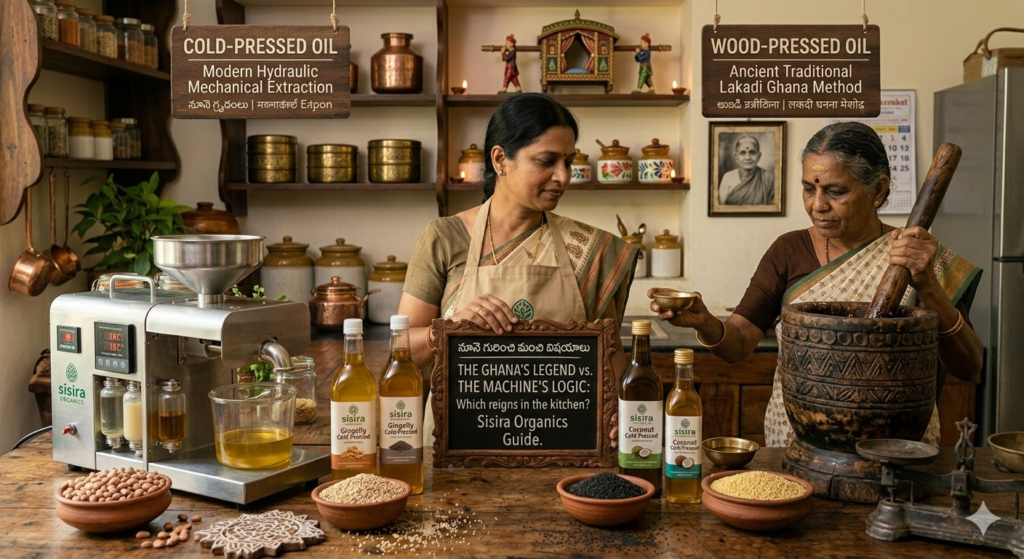
Wood pressed oil is a type of cold pressed oil – so the question is not “which is better” but rather “what is the difference.” Here is the essential distinction: cold pressed is the broad category — any oil extracted without external heat or chemical solvents, whether using wooden or steel equipment. Wood pressed is the traditional Indian method within that category – specifically using a wooden chekku, ghani, or kolhu at temperatures below 40°C.
The verdict: Both are dramatically better than refined oil. Wood pressed holds a nutritional and flavour edge — lower temperature, richer aroma, deeper bioactive retention – and is the gold standard for authentic Indian cooking. Modern steel cold pressed is an excellent alternative with wider availability and consistent quality. At Sisira Organics, all oils are extracted using the traditional Lakdi Ghani wooden press – giving you the best of both worlds. (Cold Pressed Cooking Oil or Wood Pressed Oil)
Walk into any health food store or browse any organic oil website in India today and you will find two terms used constantly — sometimes interchangeably, sometimes as if they are completely different products: cold pressed oil and wood pressed oil. Both promise purity. Both claim nutritional superiority over refined oil. Both seem to be targeting the same health-conscious buyer. So which one do you actually choose?
The confusion is understandable — and it is made worse by the fact that many brands use both terms on the same label without explaining the relationship between them. Some brands call their oil “cold pressed” when they mean wood pressed. Others call their oil “wood pressed” when the extraction actually uses a modern steel expeller. The terminology has become so loosely applied that it has started to lose meaning.
This guide cuts through the confusion decisively. We explain exactly what cold pressed oil is, what wood pressed oil is, how they relate to each other, where they differ meaningfully, and — most importantly — which one you should choose for your kitchen, your health, and your cooking. By the end, you will never be confused by an oil label again.
Table of Contents
- What is Cold Pressed Oil? The Complete Definition
- What is Wood Pressed Oil? The Traditional Indian Method
- The Relationship Between the Two — A Clear Diagram
- 7 Key Differences: Cold Pressed vs Wood Pressed Oil
- Side-by-Side Comparison Table
- Which is Better for Cooking, Health & Taste?
- When to Choose Cold Pressed vs Wood Pressed
- How to Read Oil Labels — Decoding the Fine Print
- Sisira Organics — Genuinely Wood Pressed, Traditionally Pure
- Frequently Asked Questions
What is Cold Pressed Oil? The Complete Definition
Cold pressed oil is a broad term for any oil extracted from seeds, nuts, or fruits through mechanical pressure alone — without applying external heat or using chemical solvents. The defining characteristic is temperature: during the extraction process, the oil must remain below a specified threshold — generally accepted as below 50°C (122°F) — which ensures that heat-sensitive nutrients, antioxidants, and flavour compounds are preserved.
In practical terms, “cold pressed” covers a spectrum of extraction methods — from the slowest traditional wooden presses to modern stainless steel screw expellers — as long as the temperature constraint is met. This is an important nuance that many buyers miss: not all cold pressed oils are made the same way, even though they carry the same label.
The important catch about “cold pressed”: The term “cold pressed” has no official regulated definition in India. A steel expeller operating at 60–80°C due to metal friction can still be labelled “cold pressed” because no external heat was added. The heat was generated by friction — which is technically different. This means some oils labelled “cold pressed” are extracted at temperatures significantly higher than what a genuine wooden press produces. The distinction matters — at 60–80°C, heat-sensitive antioxidants and volatile flavour compounds begin to degrade.
What is Wood Pressed Oil? The Traditional Indian Method
Wood pressed oil — called chekku ennai in Tamil, kachi ghani or kolhu tel in Hindi, marachekku oil in Malayalam, chekku nallennai in Kannada, and ganuga nune in Telugu — refers specifically to oil extracted using a traditional wooden mortar and pestle system. Seeds are fed into a wooden barrel or vessel, and a rotating wooden pestle — driven historically by bullocks, today by electric motors — crushes the seeds slowly under steady, gentle pressure.
The critical operational feature of a genuine wooden press is its extremely low rotation speed — typically below 15 RPM. This glacially slow movement generates almost no friction heat. Extraction temperatures in a properly operated wooden chekku or ghani stay consistently below 35–40°C — often at room temperature. No external heat. No metal-to-metal friction. No speed-induced thermal degradation.
The result is oil in its most authentic, unaltered form — retaining the seed’s original colour, full aromatic profile, and the highest possible concentration of heat-sensitive nutrients. This is the method described in Ayurvedic texts. This is the method your grandparents’ generation accessed at the local chekku mill. And this is the method Sisira Organics uses for every oil in its range.
Historical context: The wooden ghani has been in continuous use across the Indian subcontinent for over 5,000 years. The Arthashastra — Chanakya’s ancient treatise on statecraft, written around 300 BCE — contains references to oil pressing operations using animal-driven ghanis as part of organised Indian commerce. The Charaka Samhita prescribes specific oils extracted through traditional pressing for Ayurvedic therapeutic use. The wooden press is not an artisanal curiosity — it is a proven, time-tested technology whose gentle extraction mechanism modern nutritional science is only now fully understanding and validating.
The Relationship Between Cold Pressed and Wood Pressed Oil – Made Simple
The single most important thing to understand before comparing these two oils is their logical relationship. It is not a rivalry — it is a hierarchy:
All Cooking Oils
Unrefined / Cold Pressed Oils
Extracted mechanically without external heat or chemicals. Temperature below 50°C.
🪵 Wood Pressed
Traditional wooden chekku / ghani / kolhu. Below 40°C. Maximum nutrient retention. Richest aroma.
Chekku · Kachi Ghani · Lakdi Ghani · Marachekku
⚙️ Steel Expeller Cold Pressed
Modern stainless steel press. Up to 50°C (friction may push higher). High nutrient retention. Milder aroma.
Cold Pressed · Expeller Pressed
Refined Oils — Avoid
Hexane solvent + 200–320°C heat + bleaching + deodorising + synthetic preservatives. Nutritionally depleted.
The key insight: Every wood pressed oil is cold pressed — but not every cold pressed oil is wood pressed. Wood pressing is the traditional, artisanal sub-category within the broader cold pressed family. When you see “wood pressed” on a label, it is telling you something more specific and more traditional than “cold pressed” alone. When you see only “cold pressed,” it could mean wooden extraction, steel expeller, or anything in between — which is why reading the label carefully matters.
7 Key Differences Between Cold Pressed and Wood Pressed Oil
Now that we understand the relationship, let’s examine where the two genuinely differ — and why those differences matter for your health and your kitchen.
Extraction Equipment — Wood vs Steel
🪵 Wood Pressed
Uses a traditional wooden mortar (barrel) and rotating wooden pestle — the chekku, ghani, or kolhu. The wooden surfaces have minimal heat conductivity, so almost no friction heat transfers to the seeds during pressing.
⚙️ Cold Pressed (Steel)
Uses a modern stainless steel screw expeller press. Metal conducts heat more readily than wood. Even at controlled speeds, steel-to-steel friction can generate temperatures of 50–80°C in some machines — still far below refining temperatures, but higher than wooden pressing.
Impact: Wood pressing consistently achieves lower extraction temperatures, making it more protective of heat-sensitive compounds — particularly volatile aromatic molecules and the most delicate antioxidants.
Extraction Temperature — The Critical Variable
🪵 Wood Pressed
Below 35–40°C — often at ambient room temperature. The slow rotation speed (below 15 RPM) and wooden surfaces generate minimal friction heat. This is the lowest possible extraction temperature for any oil production method.
⚙️ Cold Pressed (Steel)
Below 50°C in the best machines; up to 60–80°C in some commercial steel expellers operating at higher speeds. Quality brands control this carefully — but the metal press inherently generates more friction heat than wood.
Impact: Temperature is the single most important variable in oil extraction. At 40°C, all nutrients are intact. At 60°C, some volatile compounds begin to degrade. At 80°C, antioxidant loss accelerates. Wood pressed oil has a structural temperature advantage that steel cannot fully replicate.
Nutrient Retention — What Survives the Press
🪵 Wood Pressed
Maximum retention — Vitamin E, polyphenols, phytosterols, volatile aroma compounds, and all heat-sensitive bioactives survive intact. The lower temperature and slower process preserve the oil’s full nutritional fingerprint as close to the original seed as possible.
⚙️ Cold Pressed (Steel)
High retention — Significantly better than refined oil. Fatty acid profiles, phytosterols, and most antioxidants are preserved. However, the most volatile compounds — the fragile aromatic molecules and some delicate polyphenols — may lose a small percentage due to friction heat.
Impact: Both are nutritionally excellent and vastly superior to refined oil. Wood pressed has a marginal edge in preserving the most heat-sensitive compounds. A 2025 Frontiers in Nutrition (USDA) study confirms cold pressed oils retain phytosterols and Vitamin E — but notes the distinction within cold pressed methods matters for the most delicate bioactives.
Aroma & Flavour — The Sensory Difference
🪵 Wood Pressed
Rich, deep, unmistakable — Wood pressed sesame oil fills a kitchen with a toasty, nutty depth the moment it is opened. Wood pressed groundnut oil carries warm, roasted peanut character. Wood pressed coconut oil has an authentic, fresh coconut aroma. These flavours transform dishes rather than simply cooking them.
⚙️ Cold Pressed (Steel)
Present but milder — The natural seed aroma is preserved, but the friction heat in steel expellers can diminish the most volatile aromatic molecules. Cold pressed steel groundnut oil smells of peanuts — but less intensely than its wood pressed equivalent.
Impact: For authentic Indian cooking — where the oil’s character is an integral part of the dish’s identity — wood pressed oils produce a more pronounced and authentic flavour experience. For those who prefer a cleaner, more neutral cooking medium, cold pressed steel oils may be preferred.
Extraction Speed & Batch Size
🪵 Wood Pressed
Slow — hours per batch. A traditional chekku processes seeds slowly at below 15 RPM. This limited throughput means smaller batches, lower yield per kilogram of seeds, and a production model that does not scale the way industrial extraction does.
⚙️ Cold Pressed (Steel)
Faster — higher throughput. Steel screw expellers operate more quickly and produce more oil per hour from the same quantity of seeds. This makes cold pressed steel operations more commercially scalable while still maintaining quality.
Impact: The slower extraction of wood pressing is precisely what makes it produce superior oil — but it also makes genuine wood pressed oil more expensive and less widely available than steel cold pressed alternatives.
Price — Why the Difference Exists
🪵 Wood Pressed
Higher price — Lower yield per kg of seeds (30–40% less than steel), slower production, more labour-intensive process, and typically premium seed sourcing all contribute to a higher per-litre price. The price reflects genuine quality and effort.
⚙️ Cold Pressed (Steel)
Moderately priced — Higher efficiency than wooden pressing means more oil per kg of seeds, lower labour costs, and a slightly lower retail price. Still significantly more expensive than refined oil — which is appropriate given the quality difference.
Warning: If you find a “wood pressed” or “cold pressed” oil priced similarly to refined oil — it is almost certainly not genuine. Authentic unrefined extraction always costs more than chemical extraction. Suspiciously low-priced “cold pressed” or “wood pressed” oils are a major red flag for adulteration or mislabelling.
Cultural & Ayurvedic Authenticity
🪵 Wood Pressed
Rooted in 5,000 years of Indian tradition — specifically prescribed in Ayurvedic texts for cooking, abhyanga (massage), oil pulling, and medicinal preparation. The wooden ghani is the equipment referenced in classical Indian health science.
⚙️ Cold Pressed (Steel)
A 20th century innovation — steel expeller pressing was developed in the 1900s as a more efficient mechanical alternative to wooden pressing. It produces excellent oil but lacks the cultural and Ayurvedic heritage of the traditional wooden method.
Impact: For Ayurvedic practices — oil pulling, abhyanga, specific therapeutic applications — classical texts and traditional practitioners recommend wood pressed oils specifically. If Ayurvedic authenticity matters to you, wood pressed is the appropriate choice.
Side-by-Side Comparison: Cold Pressed vs Wood Pressed vs Refined Oil
For complete context, here is how all three categories stack up across every dimension that matters for your health and kitchen:
Which is Better for Cooking, Health & Taste? — The Verdict
After examining every dimension, here is the clear, honest verdict — broken down by the four criteria that matter most to most buyers:
NUTRITION
Winner: Wood Pressed Oil 🪵
The lower extraction temperature of wooden pressing preserves the maximum possible concentration of Vitamin E, polyphenols, phytosterols, volatile bioactives, and natural flavour compounds. For someone prioritising the highest possible nutritional density from their cooking oil, wood pressed is the evidence-backed choice. Steel cold pressed is close behind — and both are dramatically better than refined.
FLAVOUR
Winner: Wood Pressed Oil 🪵
There is no question here. Wood pressed oils taste and smell more authentically of their source seed than any steel cold pressed equivalent. If you have ever cooked with genuinely fresh chekku sesame oil or ghani groundnut oil, you understand the difference immediately. This is not subtle — it is the difference between an oil that flavours your food and one that merely cooks it.
AVAILABILITY
Winner: Cold Pressed (Steel) ⚙️
Genuine wood pressed oil requires traditional equipment, skilled operators, and small-batch production that limits scalability. Cold pressed steel expeller oils are more widely available, produced in higher volumes, and generally more consistently stocked. For buyers outside major cities or in regions where traditional chekku mills are rare, quality cold pressed steel oils are a more practical option.
VALUE
Winner: Cold Pressed (Steel) ⚙️ (on price per litre)
Wood pressed oil costs more per litre — a direct result of its slower production and lower yield. If budget is a primary consideration, quality cold pressed steel expeller oil delivers excellent nutrition at a lower price point. The marginal nutritional difference between the two does not necessarily justify the price premium for every household.
🏆 Overall Verdict
If you want the absolute best — maximum nutrition, most authentic flavour, deepest cultural and Ayurvedic heritage, and the oil that genuinely comes closest to what nature produced in the seed — wood pressed oil is the gold standard. If you want an excellent, nutritionally complete, chemical-free cooking oil at a slightly lower price with wider availability, quality cold pressed steel expeller oil is a strong and worthy choice. What both have in common — and what truly matters — is that both are infinitely better than refined oil. The real decision should never be between cold pressed and wood pressed. It should be between unrefined and refined. Choose unrefined. Every time.
When to Choose Cold Pressed vs Wood Pressed — Practical Guide
Here is a practical decision guide for different cooking needs, health goals, and use cases:
How to Read Oil Labels — Decoding the Fine Print
The oil market in India is plagued with mislabelled and misrepresented products. Here is how to read any cold pressed or wood pressed oil label with confidence:
✅ Labels that indicate genuine wood pressing
Wood pressed · Chekku · Kachi ghani · Lakdi ghani · Kolhu · Marachekku · Ganuga nune — any of these on a label indicates traditional wooden extraction. These are the most trustworthy extraction descriptors for Indian cooking oils.
✅ Labels that indicate genuine cold pressing
Cold pressed · Expeller pressed · Unrefined · Virgin — these indicate mechanical extraction without chemicals. Quality depends on whether a steel or wooden press was used and at what temperature. Combine with colour and aroma verification.
🚩 Labels that are warning signs
Refined · Light · Blended · Fortified · TBHQ / BHA / BHT in ingredients — these confirm industrial processing. “Natural” and “Pure” without a specific extraction method claim are unregulated marketing terms and mean nothing in isolation.
⚠️ Labels that require scrutiny
“Cold pressed” on front + multiple ingredients on back — always read the full ingredients list. If it lists more than the oil name itself (e.g., “groundnut oil, permitted antioxidant”), the oil has been refined or treated regardless of the front label claim.
Sisira Organics — Genuinely Wood Pressed, Traditionally Pure
At Sisira Organics, we do not use the terms “cold pressed” and “wood pressed” interchangeably — because they are not the same thing. Every oil in our range is extracted using the traditional Lakdi Ghani wooden cold press method — the same slow, heat-free, wooden extraction technique that Indian households used for generations before steel expellers and industrial refineries arrived.
🌾
Farm-Sourced Seeds
Seeds sourced directly from trusted Indian farmers, grown without synthetic pesticides. Full traceability from field to press.
🪵
Traditional Lakdi Ghani
Wooden cold press extraction below 45°C — not steel expeller shortcuts. Every batch pressed at the lowest possible temperature to retain full nutritional integrity.
🚫
Zero Chemicals — Ever
No hexane. No bleaching agents. No deodorising. No TBHQ or BHA. One ingredient per bottle — the oil. Nothing added, nothing removed.
📦
Small Batch, Fresh Delivery
Pressed in small batches and delivered directly to your door. No long-term warehouse storage — the oil that arrives is genuinely fresh.
🛢️
Five Traditional Oils
Groundnut · Coconut · Sesame · Safflower · Mustard — all genuinely wood pressed, all traditionally pure.
🚚
Pan-India Delivery
Free shipping on orders above ₹799. Delivered directly to your kitchen — no middlemen, no compromise, from Visakhapatnam to Vellore.
Shop Sisira Organics
Browse our complete range of genuinely wood pressed cooking oils — Groundnut, Coconut, Sesame, Safflower, and Mustard. Traditionally extracted. Farm-sourced. Chemical-free.
✅ Free shipping above ₹799 · ✅ 100% wood pressed · ✅ Pan-India delivery
Frequently Asked Questions
Which is better: cold pressed cooking oil or wood pressed oil?
Wood pressed oil is technically a type of cold pressed oil — so the comparison is nuanced. Wood pressed (chekku / kachi ghani) uses a traditional wooden press at below 40°C, retaining maximum nutrients, the richest natural aroma, and the deepest bioactive profile. Steel cold pressed operates at slightly higher temperatures and has a milder flavour. For maximum nutrition, authentic Indian flavour, and Ayurvedic use, wood pressed is the gold standard. For consistent availability and slightly lower cost, quality cold pressed steel oils are an excellent alternative. Both are vastly superior to refined oil.
Is wood pressed oil the same as cold pressed oil?
Not exactly. Wood pressed oil is a specific type of cold pressed oil — but cold pressed is a broader category. All wood pressed oils are cold pressed (extracted without external heat or chemicals), but cold pressed oils can also be produced using modern steel expeller presses that operate at slightly higher temperatures due to metal friction. The wooden press is the traditional, artisanal method that consistently achieves lower extraction temperatures and preserves more volatile aroma compounds.
What is the difference between cold pressed and wood pressed mustard oil?
Wood pressed mustard oil (kachi ghani) is extracted using a traditional wooden rotating press at below 40°C. Cold pressed steel expeller mustard oil operates at slightly higher temperatures (up to 50°C) due to metal friction. Both are chemical-free and far superior to refined mustard oil. Wood pressed kachi ghani delivers a more pungent, aromatic, full-character mustard oil — the kind traditionally used in North Indian cooking, Bengali cuisine, and authentic hair care. Cold pressed steel may have a slightly milder flavour profile.
Why is wood pressed oil more expensive than cold pressed oil?
Wood pressed oil requires a slower, more labour-intensive traditional process. The wooden chekku rotates at below 15 RPM, yielding 30–40% less oil per kilogram of seeds compared to steel expeller pressing. The smaller batch size, higher labour involvement, traditional equipment maintenance, and typically premium seed sourcing all contribute to a higher price per litre. The price is a genuine reflection of quality and effort — not marketing inflation.
Can I use cold pressed or wood pressed oil for deep frying?
Yes — both wood pressed and cold pressed groundnut oil (smoke point ~230°C) and mustard oil (~250°C) are suitable for deep frying. Their high smoke points make them safe at frying temperatures. Cold pressed sesame, coconut, and safflower oils have lower smoke points (~160–175°C) and are better for medium-heat cooking, tempering, and finishing rather than repeated deep frying.
How do I identify genuine wood pressed oil when buying online?
Look for: (1) Label clearly stating “wood pressed,” “chekku,” “kachi ghani,” or “lakdi ghani”; (2) Rich natural colour — golden-amber for groundnut, deep amber for sesame, pale gold for coconut; (3) Strong, authentic seed-specific aroma; (4) Single ingredient — only the oil, no preservatives or antioxidants listed; (5) Slight natural sediment as evidence of traditional pressing and natural filtration; (6) Realistic shelf life of 6–10 months, not 18–24 months.
Which Sisira Organics oils are wood pressed?
All five Sisira Organics oils — Groundnut Oil, Coconut Oil, Sesame Oil, Safflower Oil, and Mustard Oil — are extracted using the traditional Lakdi Ghani wooden cold press at below 45°C. None use steel expeller presses. Every bottle contains a single ingredient and no synthetic additives of any kind.
Conclusion: Same Family, Different Heritage — Both Worth Choosing
The question — cold pressed cooking oil or wood pressed oil, which is best? — has a nuanced but clear answer. Wood pressed is a type of cold pressed. It is the traditional, lower-temperature, more nutritionally complete, and more flavourful variant within the cold pressed family. Cold pressed steel expeller oil is an excellent modern alternative that delivers most of the same benefits at a slightly lower cost and with wider availability.
What both share — and what makes both of them the right choice — is what they are not: they are not refined, they are not chemically extracted, they are not bleached, deodorised, or loaded with synthetic preservatives. In a market where the majority of cooking oils sold in India are precisely all of those things, choosing either cold pressed or wood pressed oil is a meaningful, impactful health decision.
At Sisira Organics, we have made that decision simple: every oil we offer is genuinely wood pressed — the gold standard within the cold pressed family — so you never have to wonder what method was used, what temperature the seeds were pressed at, or what is in the bottle. The answer is always the same: tradition, purity, and nothing else.
Experience the Gold Standard
Shop Sisira Organics’ complete range of traditionally extracted wood pressed cooking oils — the most nutritious, most authentic, and most flavourful form of cold pressed oil available in India.
✅ Free shipping above ₹799 · ✅ 100% Lakdi Ghani extracted · ✅ Pan-India delivery
Explore More Oil Guides from Sisira Organics