















Quick Answer
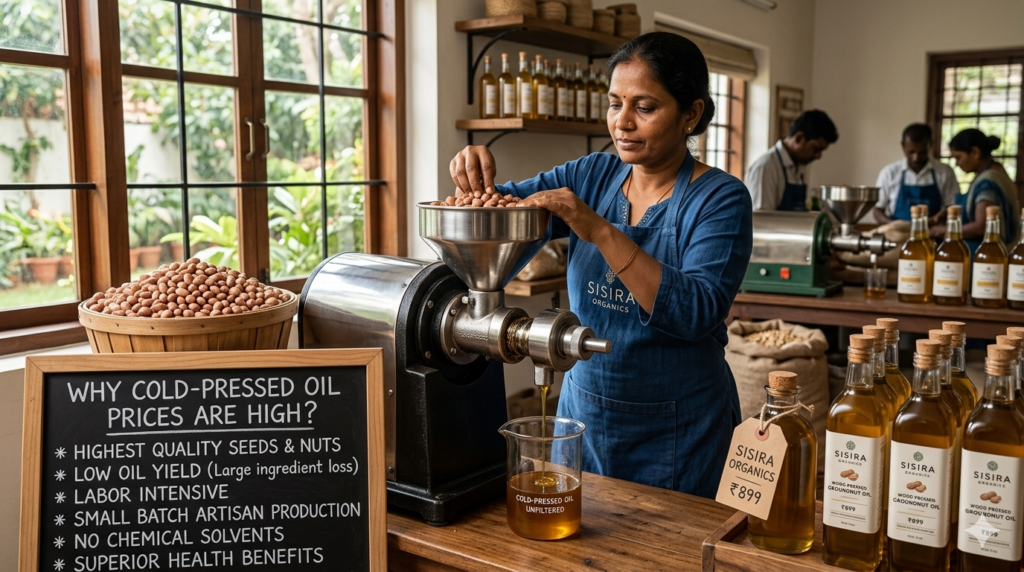
Why are cold pressed oil prices high? Because genuine cold pressed oil costs significantly more to produce at every single stage — from raw material to bottling. It requires 2.5–3 kg of premium seeds per litre (vs ~1.2 kg for refined oil), uses a slower traditional extraction process with no chemical yield-boosting shortcuts, is produced in small batches with higher labour costs, and is tested and certified for quality.
The short answer: cold pressed oil prices are high because cold pressed oil is genuinely more expensive to make — and the price difference reflects real quality, not marketing. This guide explains all 8 reasons with actual cost data, so you know exactly what you are paying for.
Why are cold pressed oil prices high — this is the question every first-time buyer asks when they pick up a bottle of wood pressed groundnut oil or chekku sesame oil and see the price tag. At ₹280–400 per litre, cold pressed oils can cost two to three times more than the refined oils sitting next to them on the shelf. For a household cooking with a litre of oil every week, that difference adds up quickly. And without a clear understanding of why the price is higher, it can feel like an unjustified premium.
The truth is the opposite. Cold pressed oil prices are high not because of branding or marketing — but because of hard, verifiable production economics. Every stage of the cold pressing process, from the seeds used to the equipment operated to the packaging chosen, costs more than the industrial refining alternative. And the reason it costs more is precisely the reason it is better for you: nothing is cut, nothing is skipped, and no chemical shortcuts are taken.
In this complete guide, we break down all 8 reasons why cold pressed oil prices are high — with real cost data, production economics, and a transparent look at what you are actually paying for when you choose genuine cold pressed oil from Sisira Organics.
Table of Contents
- The Price Gap — Cold Pressed vs Refined Oil in Numbers
- 8 Reasons Why Cold Pressed Oil Prices Are High
- Real Cost Breakdown: What Goes Into 1 Litre of Cold Pressed Oil
- Is Cold Pressed Oil Worth the Higher Price? The Honest Answer
- Red Flags: When “Cold Pressed” Oil is Suspiciously Cheap
- Sisira Organics — Quality You Can See, Taste & Trust
- Frequently Asked Questions
The Price Gap — Cold Pressed vs Refined Oil in Real Numbers
Before we explore the reasons behind the price difference, it helps to understand the scale of that difference. Here is a realistic price comparison for common cooking oils available in India in 2026:
On average, cold pressed oil costs approximately 1.8 to 2.5 times more than its refined equivalent. That is a significant difference — and it deserves a clear, honest explanation. Here are the 8 specific reasons why cold pressed oil prices are high.
Why Are Cold Pressed Oil Prices High? 8 Honest Reasons Explained
Understanding why cold pressed oil prices are high starts with the production process — and each stage reveals a genuine cost that refined oil avoids by taking shortcuts that compromise quality.
Lower Oil Yield — More Seeds Per Litre
The Biggest Cost Driver
This is the single most important reason why cold pressed oil prices are high — and it is purely mathematical. Cold pressing extracts only 40–45% of the available oil from the seed through gentle mechanical pressure. This means to produce 1 litre of cold pressed groundnut oil, you need approximately 2.5 to 3 kilograms of premium groundnuts.
Industrial hexane solvent extraction, by contrast, extracts up to 97% of the available oil from the same seeds. The same 2.5 kg of groundnuts that yields 1 litre of cold pressed oil would yield approximately 2.1–2.3 litres when solvent-extracted. The seed cost per litre of refined oil is therefore less than half the seed cost per litre of cold pressed oil — before any other production costs are even considered.
Real numbers: With groundnuts at ₹120–150 per kg, the raw seed cost alone for 1 litre of cold pressed groundnut oil is ₹300–450. For refined oil using hexane extraction from the same seeds, the raw seed cost per litre drops to ₹140–200. This single difference accounts for the majority of the price gap — before any processing, labour, or packaging costs are added.
Premium Quality Seed Sourcing
Quality Starts at the Farm
Genuine cold pressed oil brands do not use the same bulk commodity seeds that industrial refineries buy by the tonne at rock-bottom prices. Because cold pressed extraction relies entirely on the quality of the raw seed — with no chemical treatment to mask defects or enhance flavour — only the highest quality seeds can be used.
At Sisira Organics, this means sourcing seeds directly from trusted Indian farmers — whole seeds (not split or damaged), grown without synthetic pesticides, sun-dried to optimal moisture levels, and carefully sorted before pressing. Whole seeds contain more oil and better nutritional content than commodity-grade seeds, but they cost proportionally more.
Cost impact: Premium farm-sourced whole seeds typically cost 20–40% more per kilogram than commodity bulk seeds used by industrial refineries. This premium is built into every bottle of genuine cold pressed oil — and it is what makes the flavour and nutritional profile possible in the first place.
Slow Traditional Extraction — Time is Money
The Process That Makes It Better Also Makes It Slower
A traditional wooden chekku or ghani operates at below 15 RPM — a deliberately slow rotation that generates minimal friction heat and produces oil at its purest. This is the speed that keeps extraction temperature below 40°C and preserves maximum nutrients. But it is also a speed that produces oil slowly — hours per batch, compared to the minutes-per-batch throughput of industrial steel expeller presses.
Modern steel expeller cold pressed operations run faster — still below 50°C in quality machines, but with significantly higher throughput. Even so, both methods are dramatically slower than industrial solvent extraction, which can process tonnes of oilseed per hour using continuous automated lines that require minimal human oversight.
Why this matters: Slower production means higher cost per litre — more machine-hours, more operator time, and lower volume per production run. This is not inefficiency — it is the deliberate, necessary condition for producing the lowest possible extraction temperature and the highest possible nutritional quality. The slowness is the feature, not a flaw.
Small-Batch Production — No Economies of Scale
Size Matters in Manufacturing Economics
Large industrial oil refineries process hundreds of tonnes of oilseed daily using continuous automated lines. The fixed costs — factory rent, machinery depreciation, electricity, management overheads — are spread across an enormous volume of output, reducing the cost per litre dramatically. This is what economists call economies of scale.
Cold pressed oil producers, particularly those using traditional wooden pressing methods, operate at a fraction of this scale. A small-batch cold press operation might produce 50–200 litres per day. The same fixed costs — rent, equipment, utilities, staff — are now spread across a much smaller volume of output. The result is a higher cost per litre, even before accounting for the seed yield difference.
The quality trade-off: Small-batch production is not just an economic constraint — it is a quality advantage. Smaller batches mean fresher oil, tighter quality control, and the ability to trace every batch back to its source seeds. When Sisira Organics says our oil is fresh, small-batch production is precisely why that claim is true.
No Chemical Shortcuts — Every Litre Costs What It Costs
Purity Has a Price Tag
Industrial oil refining is cheap in part because of the chemical arsenal it deploys. Hexane solvent extraction costs a fraction of mechanical pressing but extracts nearly triple the oil yield. Bleaching with activated clay is fast and cheap. Steam deodorising at 250°C takes hours but produces a shelf-stable, mass-market product. Synthetic antioxidants like TBHQ cost pennies per litre but extend shelf life to 18–24 months without refrigeration.
Cold pressed oil production uses none of these. Every step — from mechanical pressing to natural gravity settling to cloth filtration — takes longer, produces less, and costs more than the chemical equivalent. But every step that costs more is also the step that keeps the oil pure, nutritious, and free from petroleum-derived residues.
What you are NOT paying for: When you buy cold pressed oil, the price includes none of the cheap shortcuts that reduce refined oil’s cost — no hexane, no bleaching clay, no synthetic TBHQ. Every rupee of the premium reflects the absence of something harmful rather than the addition of something expensive.
Higher Labour Costs Per Litre
Traditional Methods Require Human Attention
Industrial oil production is largely automated. Seeds go in one end of a continuous processing line, refined oil comes out the other, and minimal human oversight is required per litre of output. Labour cost per litre of industrial refined oil is extremely low — a fraction of a rupee in large-scale operations.
Cold pressing — particularly traditional wooden ghani pressing — requires hands-on human involvement at every stage. Seed cleaning and sorting, loading the press, monitoring the extraction, collecting and settling the oil, quality checking, filtering, and bottling all require skilled operators whose time adds directly to the cost per litre produced. Industry data puts labour costs at approximately ₹40–60 per litre of cold pressed oil produced — a meaningful addition to the already higher seed cost.
Supporting livelihoods: The higher labour cost of cold pressed production is also a social positive — it supports skilled traditional artisans, small-scale local producers, and farming communities in a way that fully automated industrial production cannot. When you pay the premium for cold pressed oil, part of that premium supports the people who make it the right way.
Quality Testing, Certification & Compliance
Proving Purity Costs Money
Legitimate cold pressed oil producers invest in quality verification that refined oil manufacturers — who rely on standardised industrial processes — do not require to the same degree. This includes FSSAI licensing and compliance, batch-level testing for free fatty acid content and peroxide values, purity verification to confirm the absence of adulteration, and in some cases third-party lab certifications that buyers can verify independently.
For a small-batch cold pressed producer, these testing and certification costs do not have the benefit of industrial scale to absorb them. Each batch tested, each licence maintained, each certification renewed adds a per-litre cost that eventually reaches the retail price.
Why this matters for buyers: A cold pressed oil brand that invests in testing and certification is a brand you can trust. The presence of a valid FSSAI licence number and available quality documentation is one of the most reliable signals that a cold pressed oil’s price premium reflects genuine quality — not just marketing positioning.
Protective Packaging — Preserving Quality Without Chemicals
The Container Matters as Much as the Oil
Refined oil has a built-in shelf life advantage: its natural antioxidants have been destroyed, but synthetic preservatives (TBHQ, BHA) have been added to replace them. This means it can be stored in basic transparent plastic pouches — the cheapest possible packaging — for 18–24 months without quality degradation.
Cold pressed oil retains its natural antioxidants but has no synthetic backup. It is sensitive to light and heat — UV exposure accelerates oxidation and rancidity. Quality cold pressed oil producers therefore invest in dark glass bottles, food-grade opaque HDPE containers, or protective packaging that prevent light degradation. These materials cost significantly more than the transparent plastic pouches used for refined oil — but they are essential for preserving the quality that justifies the premium price.
The packaging test: The packaging choice is often a reliable quality signal. A cold pressed oil sold in transparent plastic pouches is almost certainly either refined, adulterated, or will reach you degraded. A cold pressed oil sold in dark glass or opaque food-grade containers is a brand that understands — and invests in — preserving what it produced.
Real Cost Breakdown: What Goes Into 1 Litre of Cold Pressed Oil
Here is the actual production cost breakdown for 1 litre of cold pressed groundnut oil, based on publicly available industry data from Indian cold pressed oil producers:
Source: Industry data compiled from Standard Cold Pressed Oil, NIIR India, and producer cost analysis. Prices approximate and vary by region, season, and scale.
The key takeaway: A litre of genuine cold pressed groundnut oil costs approximately ₹285–320 to produce — before any profit margin, distribution, or marketing is added. This is why the retail price of ₹280–400 per litre is not a premium — it is the actual cost of making the oil correctly. According to industry production data, any “cold pressed” groundnut oil sold significantly below ₹280 per litre cannot be genuinely produced by authentic cold pressing — the numbers simply do not work.
Is Cold Pressed Oil Worth the Higher Price? The Honest Answer
Yes — but the value needs to be understood correctly. Cold pressed oil is not “worth it” simply because it is more expensive or because health marketing says so. It is worth it because of specific, measurable differences in what you get for the money.
🧪
90% More Vitamin E
According to a 2024 study cited by India’s National Institute of Nutrition, cold pressed oils retain up to 90% of natural Vitamin E vs less than 30% in refined oils. That is a 3x difference in one of the body’s most critical antioxidants — delivered with every meal you cook.
🫀
Measurable Heart Benefits
India’s National Institute of Nutrition (2025) found that replacing refined oil with cold pressed alternatives reduces LDL cholesterol by 10–12% over 8 weeks. This is a clinically meaningful improvement — equivalent to some mild cholesterol-lowering interventions.
🚫
Zero Chemical Residues
No hexane traces, no synthetic TBHQ or BHA, no bleaching clay residues. Cold pressed oil is what it says it is — which matters particularly for families with children, pregnant women, and those managing chronic health conditions.
🍳
You Use Less — It Goes Further
Cold pressed oils have richer, more concentrated flavour profiles. Most cooks find they use 20–30% less cold pressed oil than refined oil to achieve the same depth of flavour — partly offsetting the higher per-litre price in daily use.
🌿
Authentic Flavour That Transforms Cooking
The aroma and flavour of genuine wood pressed sesame oil, groundnut oil, or coconut oil is something refined oil can never replicate — these are the tastes of traditional Indian cuisine at its most authentic. The culinary value alone justifies significant portion of the price difference.
📊
Growing Market Validates the Value
India’s cold pressed oil market reached USD 2,428.8 million in 2024 and is projected to grow at 7.2% CAGR through 2030 (Grand View Research). This rapid growth reflects millions of health-conscious Indian consumers who have decided the price premium is worth paying — consistently and repeatedly.
Red Flags: When “Cold Pressed” Oil is Suspiciously Cheap
Understanding why cold pressed oil prices are high also helps you identify when a product claiming to be cold pressed is priced in a way that makes genuine cold pressing impossible. These are the five most important red flags:
🚩
Priced at or near refined oil levels
If a cold pressed groundnut oil is priced at ₹140–180 per litre — the same as refined oil — the production economics make genuine cold pressing mathematically impossible. At that price point, even the raw seeds cost more than the retail price. The oil is either refined, adulterated with refined oil, or mislabelled.
🚩
TBHQ, BHA, or BHT listed in ingredients
These synthetic antioxidants are added to refined oils because the natural antioxidants were destroyed during processing. Their presence in an oil claiming to be “cold pressed” is definitive proof of refining — regardless of what the front label says.
🚩
Completely odourless or colourless
Cold pressed oils retain their natural colour and seed-specific aroma by definition. If an oil labelled “cold pressed” has no smell and no colour, it has been deodorised and bleached — processes that only occur in refining. Odourless = deodorized = not cold pressed.
🚩
18–24 month shelf life without refrigeration
Genuine cold pressed oils have a natural shelf life of 6–12 months, protected by their own natural antioxidants. A shelf life of 18–24 months without refrigeration requires either synthetic preservatives or very low bioactive compound content — both of which indicate refining has occurred.
🚩
No transparent sourcing information
Genuine cold pressed oil producers are proud of where their seeds come from and how their oil is made. Brands that cannot or will not share this information are hiding something — usually that their “cold pressed” label does not reflect their actual production process.
Sisira Organics — Quality You Can See, Taste, and Trust
Every factor that makes cold pressed oil prices high — premium seed sourcing, traditional wooden extraction, small-batch production, zero chemical shortcuts, quality testing, protective packaging — is present in every bottle of Sisira Organics oil. We do not cut corners to lower prices. We price our oils at what genuine cold pressing actually costs to do correctly.
🌾
Farm-Sourced Premium Seeds
Direct from trusted Indian farmers — whole, premium-grade seeds with full traceability. No commodity bulk purchasing, no anonymous supply chain.
🪵
Traditional Lakdi Ghani Extraction
Wooden cold press below 45°C — the lowest possible extraction temperature, the highest possible nutrient retention. No steel expeller shortcuts.
🚫
Zero Chemicals — Always
No hexane. No bleaching. No deodorizing. No TBHQ, BHA, or BHT. One ingredient per bottle. Nothing added, nothing removed.
📦
Small Batches, Always Fresh
Pressed in small batches and delivered directly to your door — no long warehouse storage that degrades the quality you paid for.
✅
FSSAI Certified
Every Sisira Organics product carries a valid FSSAI license — quality and food safety compliance you can verify independently.
🚚
Pan-India Delivery
Free shipping on orders above ₹799 — delivered directly to your kitchen across India, no middlemen, no compromise.
Shop @ Sisira Organics
Browse our complete range of genuinely wood pressed cooking oils — Groundnut, Coconut, Sesame, Safflower, and Mustard – priced at what real cold pressing actually costs.
✅ Free shipping above ₹799 · ✅ 100% wood pressed · ✅ Pan-India delivery
Frequently Asked Questions
Why are cold pressed oil prices high compared to refined oil?
Cold pressed oil prices are high because of 8 genuine production economics: lower oil yield per kg of seeds, premium quality seed sourcing, slow traditional extraction, small-batch production with no economies of scale, zero chemical shortcuts, higher labour costs per litre, quality testing and FSSAI certification expenses, and protective packaging. Refined oil is cheaper because chemical hexane extraction nearly triples oil yield from the same seeds, industrial scale reduces fixed costs dramatically, and multiple quality shortcuts are taken at every stage.
How many kg of seeds are needed to make 1 litre of cold pressed oil?
Approximately 2.5 to 3 kg of premium groundnuts are needed per litre of cold pressed groundnut oil, as cold pressing extracts only 40–45% of available oil. For sesame oil, 3–4 kg of seeds per litre is typical. Compare this to industrial hexane extraction which recovers up to 97% of oil — requiring barely 1.1–1.2 kg of seeds per litre. This seed yield difference is the single biggest cost driver in cold pressed oil prices.
Is cold pressed oil worth the high price?
Yes — because it retains up to 90% of natural Vitamin E (vs less than 30% in refined oils), contains zero chemical residues, forms no trans fats, and delivers authentic flavour that refined oil cannot replicate. Additionally, cold pressed oil’s richer flavour means most cooks use 20–30% less per meal, partially offsetting the higher per-litre price. For daily family cooking, the nutritional and culinary value makes cold pressed oil the better long-term investment.
What is a realistic price for genuine cold pressed groundnut oil in India?
Based on industry production cost data, genuine cold pressed groundnut oil should be priced between ₹280–400 per litre to be economically viable for authentic cold pressing. Any cold pressed groundnut oil priced significantly below ₹280 per litre should be treated with caution — at that price point, the raw seed cost alone exceeds the retail price, making genuine cold pressing mathematically impossible without adulteration or mislabelling.
Why is wood pressed oil more expensive than regular cold pressed oil?
Wood pressed oil (chekku / kachi ghani) uses a traditional wooden press operating below 15 RPM — producing the lowest possible extraction temperature (below 40°C) but also the lowest yield per batch. Slower process, smaller batch sizes, wooden equipment maintenance, and premium seed quality used in wood pressing all add cost compared to modern steel expeller cold pressed oils. The price premium for genuine wood pressed reflects a real difference in temperature, process, and nutritional outcome.
Where can I buy genuine cold pressed oil at a fair price in India?
You can order genuine, traditionally wood pressed oils directly from Sisira Organics — with pan-India delivery and free shipping above ₹799. Our oils are priced at what genuine Lakdi Ghani wood pressing actually costs to do correctly — not marked up for branding, not marked down by cutting production corners.
Conclusion: The Price Is Not High — The Standard Is
Why are cold pressed oil prices high? Because they reflect every good decision made during production — premium seeds, slow extraction, no chemical shortcuts, small batches, quality testing, protective packaging. Remove any of these decisions and the price drops immediately. So does the quality.
The refined oil sitting next to it on the shelf is not “affordable” — it is cheap because it was made cheaply, with petroleum-derived solvents, high-heat destruction of nutrients, chemical bleaching, synthetic preservatives, and mass industrial efficiency that has nothing in common with the seed it started from. You are not saving money by buying refined oil. You are accepting a nutritionally depleted product at a price that reflects its depleted production process.
Cold pressed oil prices are not high. The standard for what cooking oil should be — pure, nutritious, chemical-free, and authentically made — is simply higher than what most commercial oils bother to meet. When you pay for cold pressed oil from a transparent, genuine producer like Sisira Organics, you are not paying a premium. You are paying the actual cost of food made the right way.
Pay for Quality. Know What You’re Getting.
Shop Sisira Organics wood pressed oils — farm-sourced, traditionally extracted, FSSAI certified, and delivered fresh across India. Free shipping above ₹799.
✅ Groundnut · Coconut · Sesame · Safflower · Mustard
You Might Also Find These Helpful