















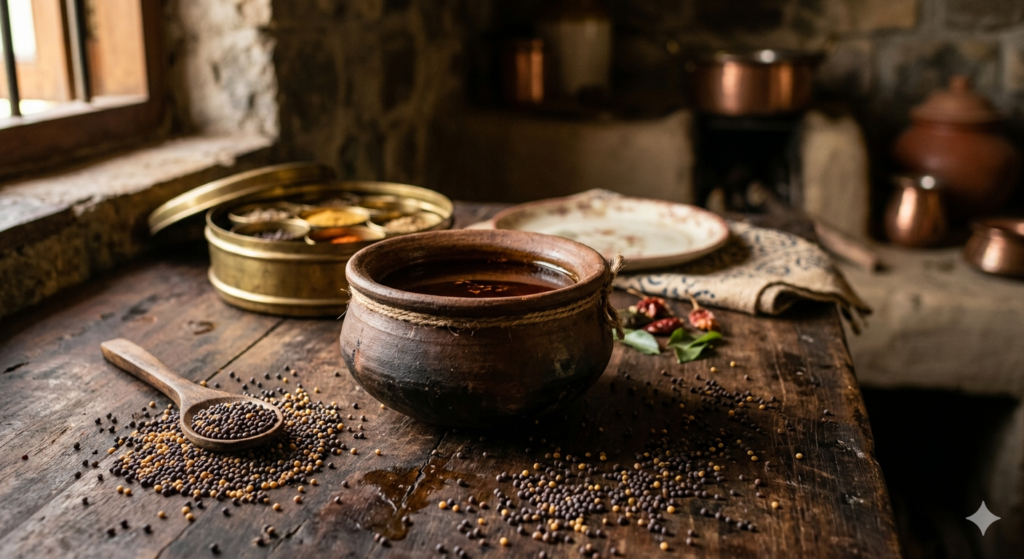
Quick Answer
Wood pressed mustard oil (also called kachi ghani mustard oil) is extracted from raw mustard seeds using a traditional wooden cold-press method at temperatures below 45°C. It retains its sharp natural pungency, high erucic acid content, glucosinolates, and Omega-3 fatty acids — all of which are destroyed in refined mustard oil. It is widely used across North and East India for cooking, hair care, skin massage, and Ayurvedic therapy.
Walk into any traditional kitchen in Punjab, Bihar, West Bengal, or Rajasthan, and you’ll find one oil that anchors nearly every dish — mustard oil. Its sharp, pungent aroma and golden-amber colour are as integral to North Indian cooking as the spices themselves. But mustard oil, like most oils today, exists on a spectrum — from heavily refined, odourless versions to the authentic, traditionally extracted wood pressed mustard oil that your ancestors actually used.
In this comprehensive guide, we cover everything about wood pressed mustard oil — what it is, how it’s made, its science-backed health benefits, uses for hair and skin, how to identify genuine kachi ghani oil, and what to look for when buying the best wood pressed mustard oil in India.
Table of Contents
- What is Wood Pressed Mustard Oil?
- How is Kachi Ghani Mustard Oil Made?
- Nutritional Profile & Key Compounds
- Health Benefits of Wood Pressed Mustard Oil
- Benefits for Hair Growth & Scalp Health
- Benefits for Skin
- Using Wood Pressed Mustard Oil for Cooking
- Black Mustard Oil vs Yellow Mustard Oil
- How to Identify Genuine Wood Pressed Mustard Oil
- Buying Guide — What to Look For
- Frequently Asked Questions
What is Wood Pressed Mustard Oil?
Wood pressed mustard oil is extracted from raw mustard seeds — either black mustard (Brassica nigra) or yellow mustard (Brassica hirta) — using a traditional wooden press known as a chekku or ghani. Unlike modern industrial extraction, no chemical solvents, external heat, or refining agents are used. The result is a deeply golden, strongly aromatic oil that contains the full spectrum of nutrients present in the original mustard seed.
In North India, this is commonly known as kachi ghani sarson ka tel — “kachi” meaning raw or unrefined, “ghani” referring to the crushing device. In culinary and health traditions across the subcontinent, kachi ghani mustard oil has always been the gold standard — prized not just for cooking but for seasonal body massages, hair conditioning, and even wound care.
Did you know? The distinctive pungency of mustard oil comes from a compound called allyl isothiocyanate, which is released when glucosinolates in the seeds are broken down during pressing. This compound has powerful antimicrobial, anti-inflammatory, and decongestant properties — and it only survives in cold-pressed, unrefined mustard oil. Refined mustard oil loses most of this compound during high-heat processing.
How is Kachi Ghani Mustard Oil Made?
The traditional kachi ghani process is elegantly simple — and that simplicity is precisely what makes the oil so good.
Step 1
Raw mustard seeds are cleaned and sorted to remove impurities and damaged seeds
Step 2
Seeds are fed into the rotating wooden ghani — a mortar and pestle device that crushes seeds slowly
Step 3
Oil is extracted at below 45°C — no external heat is applied, preserving all volatile compounds
Step 4
Oil is naturally settled and filtered — no bleaching, deodorising, or chemical treatment
Compare this to refined mustard oil, which involves hexane solvent extraction at temperatures above 180–200°C, followed by bleaching with acids, deodorising with steam, and adding antioxidant chemicals for shelf life. The two products share a name but are nutritionally worlds apart.
Nutritional Profile of Wood Pressed Mustard Oil
Wood pressed mustard oil has one of the most complex and beneficial fatty acid and bioactive compound profiles of any cooking oil. Here’s what makes it nutritionally unique:
What sets mustard oil apart from most other cooking oils is its near-ideal Omega-6 to Omega-3 ratio of approximately 2:1 — far better than sunflower oil (60:1) or refined vegetable oil blends. This balanced fatty acid ratio is associated with reduced chronic inflammation and better cardiovascular outcomes.
Health Benefits of Wood Pressed Mustard Oil
Used for thousands of years in Ayurvedic medicine and traditional North Indian cooking, wood pressed mustard oil offers a range of benefits that modern nutritional science is now beginning to validate.
Supports Heart Health
The balanced Omega-3 and Omega-9 fatty acid content helps lower LDL cholesterol and reduce arterial inflammation. Studies suggest regular mustard oil consumption is linked to lower rates of cardiovascular disease in Indian populations.
Powerful Antimicrobial
Glucosinolates and allyl isothiocyanate are natural antibacterial and antifungal agents. This is why mustard oil has been used for centuries in pickling — it naturally inhibits microbial growth.
Natural Decongestant
Steam inhalation with mustard oil or chest massages with warm mustard oil are traditional remedies for cold, cough, and congestion — backed by its allyl isothiocyanate content.
Anti-Inflammatory
Omega-3 alpha-linolenic acid and selenium work together to reduce systemic inflammation, making wood pressed mustard oil beneficial for those with joint pain or inflammatory conditions.
Stimulates Digestion
Mustard oil stimulates the secretion of digestive juices and bile, improving appetite and aiding in the digestion of fats and proteins — a property used in traditional Ayurvedic dietary recommendations.
Brain & Nerve Function
The Omega-3 content supports myelin sheath integrity, the protective coating around nerve fibres, contributing to healthy brain function and nerve signal transmission.
Wood Pressed Mustard Oil for Hair — Benefits & How to Use
For generations across North India, the weekly ritual of applying warm mustard oil to the scalp and hair before a bath has been a cornerstone of natural hair care. And the science behind it is solid.
Why Mustard Oil is Exceptional for Hair
- 1
Stimulates hair growth: Mustard oil contains selenium, zinc, and beta-carotene — all of which nourish hair follicles and promote new hair growth. The warming sensation on the scalp also improves blood circulation to follicles.
- 2
Fights dandruff and scalp infections: The antifungal properties of glucosinolates and allyl isothiocyanate actively combat the fungi responsible for dandruff, scalp itchiness, and seborrheic dermatitis.
- 3
Conditions and strengthens: The high fatty acid content coats and strengthens each hair strand, reducing breakage, split ends, and dryness — especially in coarse or chemically treated hair.
- 4
Delays premature greying: Traditionally used to maintain natural hair colour, mustard oil’s antioxidants protect melanocytes (pigment-producing cells) from oxidative damage that causes early greying.
- 5
Natural UV protection: Mustard oil forms a light protective layer on the hair shaft, offering some degree of protection against UV radiation and environmental pollutants.
How to Use for Hair
???? Warm 2–3 tablespoons of wood pressed mustard oil (do not overheat)
???? Part hair into sections and apply to scalp with fingertips
???? Massage in firm circular motions for 8–10 minutes
???? Apply remaining oil through the length of hair
???? Cover with a warm towel or shower cap — leave for 1–2 hours or overnight
???? Wash out with a mild, sulphate-free shampoo
???? Repeat 2–3 times a week for best results
Wood Pressed Mustard Oil for Skin
In traditional Indian households, sarson ka tel (mustard oil) has always been the first choice for infant massage, winter skin care, and treatment of dry, cracked skin. Its unique combination of fatty acids, antioxidants, and natural warming properties makes it especially effective for topical skin applications.
???? Natural Sunscreen
Mustard oil has a natural SPF of approximately 1–2 and forms a barrier against UV rays and environmental pollutants.
❄️ Winter Skin Care
The thick, warming nature of mustard oil makes it ideal for preventing dryness and chapping during cold, dry winters — especially for hands, feet, and lips.
???? Baby Massage
Used for centuries across India for newborn and infant massages to strengthen bones, improve circulation, and support healthy skin development.
???? Joint & Muscle Relief
Warm mustard oil massaged into sore joints and muscles provides natural relief from pain and stiffness — a time-tested Ayurvedic therapy for arthritis.
Using Wood Pressed Mustard Oil for Cooking
One of mustard oil’s greatest strengths as a cooking oil is its exceptionally high smoke point of approximately 250°C — one of the highest among traditional Indian oils. This makes it stable even at very high cooking temperatures, unlike olive oil or many cold pressed oils that break down and produce harmful compounds when overheated.
Best Culinary Uses
- →
Authentic pickles (achaar): The natural antimicrobial properties of mustard oil preserve pickles without any added chemicals — this is why traditional Indian pickles last for months or even years.
- →
Tadka / tempering: The base of North Indian dal, sabzi, and chutneys — mustard oil tempered with mustard seeds, dried red chillies, and asafoetida creates the quintessential North Indian aroma.
- →
Marinating meats and fish: Widely used in Bengali fish preparations (like Maacher Jhol) and Punjabi tandoori marinades where mustard oil’s sharp flavour enhances the overall dish.
- →
Deep frying: With its 250°C smoke point, wood pressed mustard oil is excellent for deep frying pakoras, pooris, and samosas — it remains stable at high heat.
- →
Salad dressings and raw applications: Mixed with lemon, salt, and spices, raw mustard oil makes a flavourful dressing for chaat, kachumber salad, and steamed vegetables.
???? Chef’s Tip: Heating wood pressed mustard oil to its smoking point briefly before cooking (“smoking the oil”) mellows the sharp pungency and rounds out the flavour — a technique used in traditional North Indian and Bengali kitchens for centuries. This is not harmful as mustard oil’s high smoke point keeps it stable throughout.
Recommended Product
Try our traditionally extracted Wood Pressed Mustard Oil — kachi ghani, unrefined, and packed with natural pungency and nutrients.
Black Mustard Oil vs Yellow Mustard Oil — Which is Better?
In India, two types of mustard seeds are commonly pressed for oil — black mustard (Brassica nigra) and yellow mustard (Brassica hirta / white mustard). Both produce excellent wood pressed oils, but they differ in flavour intensity and use cases.
How to Identify Genuine Wood Pressed Mustard Oil
The market for mustard oil in India is unfortunately plagued with adulteration — argemone oil adulteration in particular has been a public health concern. Here’s how to verify you’re buying genuine, pure, wood pressed mustard oil:
???? Smell Test
Genuine mustard oil has a strong, sharp, distinctively pungent aroma. If it smells mild or neutral — it has been refined or blended.
???? Colour Check
Pure wood pressed mustard oil is a deep amber-golden colour. Pale yellow or clear oil indicates heavy refining.
???? Refrigerator Test
Place a small amount in the fridge. Pure mustard oil may thicken slightly but will not solidify. Excessive thickening may indicate blending with other oils.
???? Label Reading
Genuine kachi ghani or wood pressed mustard oil labels should state: “100% mustard oil,” “kachi ghani,” “wood pressed,” and no added flavours or preservatives.
Buying Guide — What to Look for in the Best Wood Pressed Mustard Oil
Not all brands claiming to sell “kachi ghani” or “wood pressed” mustard oil are the same. Use this checklist to make an informed purchase:
- ✅
Single-origin seeds: The best oils source from one region known for quality mustard — Rajasthan, Punjab, or West Bengal. Multi-origin blends are harder to trace for quality.
- ✅
Third-party lab testing: Reputable brands provide lab test certificates confirming absence of adulteration (especially argemone oil) and chemical residue levels.
- ✅
Dark glass or food-grade HDPE packaging: Quality wood pressed oils are sensitive to light. Brands that bottle in dark glass or opaque containers are protecting the oil’s integrity.
- ✅
Ingredient list of one: The only ingredient should be “mustard oil.” Any additional entries for preservatives, antioxidants, or flavourings signal that it’s not truly unrefined.
- ✅
FSSAI certification: Ensure the product carries a valid FSSAI licence number — mandatory for all food products sold in India and a basic quality assurance marker.
Frequently Asked Questions About Wood Pressed Mustard Oil
What is wood pressed mustard oil?
Wood pressed mustard oil, also known as kachi ghani sarson ka tel, is extracted from raw mustard seeds using a traditional wooden rotating press at temperatures below 45°C. The process involves no chemical solvents, heat treatment, or refining — preserving the oil’s natural pungency, fatty acids, glucosinolates, and antioxidants in full.
Is wood pressed mustard oil good for health?
Yes. Wood pressed mustard oil offers a near-ideal Omega-6 to Omega-3 ratio of 2:1, supports cardiovascular health, has natural antimicrobial properties, aids digestion, and provides anti-inflammatory benefits. It is significantly healthier than refined mustard oil, which loses most of these beneficial compounds during processing.
Can I use wood pressed mustard oil for deep frying?
Yes. With one of the highest smoke points among traditional Indian oils (~250°C), wood pressed mustard oil is excellent for high-heat cooking including deep frying, tadka, and sautéing. It remains chemically stable at high temperatures, unlike lower-smoke-point oils.
Is wood pressed mustard oil good for hair growth?
Absolutely. Regular scalp massage with warm wood pressed mustard oil stimulates blood circulation to hair follicles, nourishes them with selenium, zinc, and Omega-3 fatty acids, and combats dandruff and scalp infections — all of which support stronger, faster hair growth.
What is the difference between kachi ghani and wood pressed mustard oil?
They refer to the same thing. “Kachi ghani” is the traditional Hindi term for cold-pressed or wood-pressed oil — “kachi” meaning raw/unrefined and “ghani” referring to the wooden press device. Both terms describe mustard oil extracted without heat or chemicals using a traditional press.
What is the price of wood pressed mustard oil in India?
Wood pressed mustard oil is priced higher than refined mustard oil due to its lower oil yield per kg and traditional extraction process. However, given its superior nutritional value and the fact that a little goes a long way, it represents excellent value for health-conscious households. Check our current pricing here.
Conclusion: The Gold Standard of Indian Cooking Oils
Wood pressed mustard oil is not simply a cooking ingredient — it is a deeply embedded part of Indian culinary heritage, Ayurvedic medicine, and daily wellness rituals. From the sizzle of a tadka to the soothing warmth of a scalp massage, kachi ghani mustard oil has served Indian households faithfully for thousands of years.
Modern nutritional science is now confirming what traditional wisdom always knew: this pungent, golden oil — with its Omega-3 content, antimicrobial properties, high smoke point, and rich bioactive compounds — is one of the most complete and beneficial cooking oils available. The key is buying the real thing — genuinely wood pressed, unrefined, and free from adulteration.
If you’re still using refined mustard oil or a refined vegetable oil blend in your kitchen, switching to authentic wood pressed kachi ghani mustard oil is one of the most impactful upgrades you can make — for your food, your health, and your hair.
Ready to Make the Switch?
Shop our authentic, traditionally extracted Wood Pressed Mustard Oil — kachi ghani, lab-tested, and delivered fresh across India.