















The cooking oil aisle has changed dramatically over the last decade. Where once there were only a handful of refined options, today you’ll find bottles labelled “cold pressed,” “wood pressed,” “chekku,” “expeller pressed,” “virgin,” and more. The terminology can be confusing — and some brands use these terms interchangeably even when they shouldn’t.
In this guide, we break down exactly what wood pressed oil vs cold pressed oil means, how each is made, what nutrients each retains, and which one you should choose for cooking, health, and daily use.
First, What Do Both Terms Actually Mean?
Before comparing the two, it helps to understand what each method involves at a fundamental level.
What is Cold Pressed Oil?
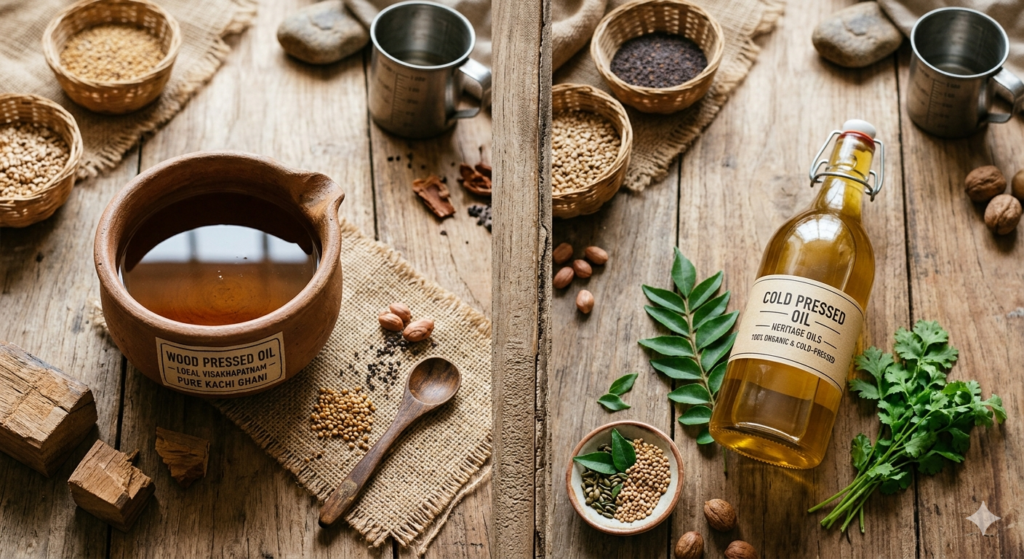
Cold pressed oil is a broad term that refers to any oil extracted without the application of external heat. The seeds or nuts are mechanically pressed — using either a steel expeller press or a traditional wooden device — and the oil flows out naturally. Because no heat is applied, the oil retains its natural fatty acids, antioxidants, and vitamins.
What is Wood Pressed Oil?
Wood pressed oil (also called chekku oil, ghani oil, or kolhu oil) is a specific type of cold pressed oil. The extraction uses a traditional wooden mortar-and-pestle system — the chekku or ghani — which has been used in India for thousands of years. A wooden pestle rotates slowly inside a wooden barrel, crushing seeds gently to release oil at temperatures below 40–45°C.
The key insight: All wood pressed oils are cold pressed oils — but not all cold pressed oils are wood pressed. Cold pressing is the category; wood pressing is the traditional Indian method within that category.
How Each Method Works — Side by Side
Understanding the extraction process reveals why the two types of oil can taste, smell, and perform differently even though both avoid high heat.
Nutrient Comparison — Wood Pressed vs Cold Pressed
Both methods preserve far more nutrients than refined oils. However, the slower, lower-temperature extraction of the wooden chekku gives wood pressed oils a slight nutritional edge — particularly in terms of antioxidants and natural flavour compounds.
???? Wood Pressed Oil
- ✅ Maximum antioxidants retained
- ✅ Richest natural aroma & flavour
- ✅ Lowest extraction temperature
- ✅ Traditional & culturally authentic
- ✅ No metal contact during pressing
- ⚠ Lower yield = higher price
- ⚠ Slower to produce
⚙️ Cold Pressed Oil (Steel)
- ✅ High nutrient retention
- ✅ No chemicals used
- ✅ Higher oil yield
- ✅ More widely available
- ✅ More affordable
- ⚠ Mild flavour & aroma
- ⚠ Some friction heat possible
Both are infinitely superior to refined oils — which are solvent-extracted, heated above 200°C, bleached, and deodorised. If your current oil is refined, switching to either cold pressed or wood pressed is a significant health upgrade.
Taste & Aroma – The Biggest Practical Difference
For most home cooks, the most noticeable difference between wood pressed and cold pressed oil is not nutritional — it’s sensory. Wood pressed oils taste and smell like the seed they came from.
-
Wood pressed sesame oil has a deep, toasty, nutty aroma that transforms a simple rice dish or stir-fry. Cold pressed sesame (steel expeller) has a milder scent.
-
Wood pressed coconut oil smells unmistakably of fresh coconut – a scent that’s completely absent in refined coconut oil and much milder in steel cold pressed versions.
-
Wood pressed groundnut oil carries a rich, earthy peanut flavour that makes it the preferred cooking medium in many Indian homes.
-
Wood pressed mustard oil has the sharpest, most pungent flavour – essential for authentic North Indian pickles and Bengali cooking.
Pro tip: If flavour matters to you — especially in traditional Indian cooking – choose wood pressed. If you prefer a neutral-tasting oil for baking or salad dressings, a steel cold pressed oil may suit you better.
Wood Pressed vs Cold Pressed Coconut Oil — Specific Comparison
Because coconut oil is the most popular traditional oil in India, this specific comparison deserves its own section.
Which is Better — Wood Pressed or Cold Pressed Oil?
The honest answer depends on what you’re optimising for:
-
For maximum nutrition and authenticity → Choose wood pressed oil. Lower temperature, slower extraction, richer nutrient profile.
-
For traditional Indian cooking flavour → Choose wood pressed oil. The aroma and taste are irreplaceable.
-
For a budget-friendly healthy option → Choose cold pressed (steel expeller). Still far superior to refined oil at a lower price.
-
For neutral-flavoured cooking or baking → Choose cold pressed (steel expeller) for a lighter taste profile.
The bottom line: both are excellent choices compared to refined oils. If you want the full traditional Indian experience — authentic flavour, maximum nutrition, and time-tested wellness — wood pressed is the gold standard.
???? Explore our range of authentic wood pressed oils — traditionally extracted, chemical-free, and delivered fresh to your doorstep.
Frequently Asked Questions
Is wood pressed oil the same as cold pressed oil?
Wood pressed oil is a type of cold pressed oil. Cold pressing is the broad category — any oil extracted without external heat. Wood pressing specifically refers to extraction using a traditional wooden chekku or ghani device. All wood pressed oils are cold pressed, but cold pressed oils are not necessarily wood pressed.
What is the difference between cold pressed and wood pressed oil?
The main differences are equipment, flavour, and temperature. Wood pressed uses a traditional wooden device at below 40°C, producing a richer flavour and aroma. Steel expeller cold pressed uses modern machinery at slightly higher temperatures. Both avoid chemicals; wood pressed is considered more traditional and nutrient-dense.
Which is healthier — wood pressed or cold pressed oil?
Both are significantly healthier than refined oils. Wood pressed oil has a slight edge in nutrient retention due to its lower extraction temperature and slower process. However, both are excellent choices for daily cooking compared to any refined or solvent-extracted oil.
What is the difference between wood pressed and cold pressed coconut oil?
Wood pressed coconut oil has a stronger coconut aroma, a slightly golden colour, and higher antioxidant content. Cold pressed coconut oil (steel expeller) is milder in flavour and clearer in colour. Both retain lauric acid and MCTs. For traditional South Indian cooking and hair care, wood pressed is preferred.
Why is wood pressed oil more expensive than cold pressed oil?
Wood pressed oil yields less oil per kilogram of seeds due to its slow, gentle extraction method. The traditional wooden chekku process is also more labour-intensive. This lower yield and higher labour cost result in a higher price per litre — but the superior flavour and nutrition make it worth it.
Conclusion: Two Great Choices, One Clear Winner for Tradition
When comparing wood pressed oil vs cold pressed oil, the honest verdict is that both are healthy, chemical-free choices that leave refined oils far behind. The difference comes down to nuance — temperature, equipment, flavour depth, and cultural authenticity.
If you cook Indian food, value authentic aroma and flavour, and want the most nutrient-dense option possible, wood pressed oil is the superior choice. If you’re looking for a budget-friendly entry into healthy cooking oils, any good cold pressed oil is a solid start.
Either way, making the switch from refined to unrefined oil is one of the best things you can do for your health — and your cooking.
???? Ready to experience the real difference? Browse our full collection of authentic wood pressed oils — traditionally made, naturally pure.