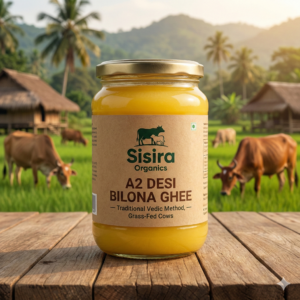
















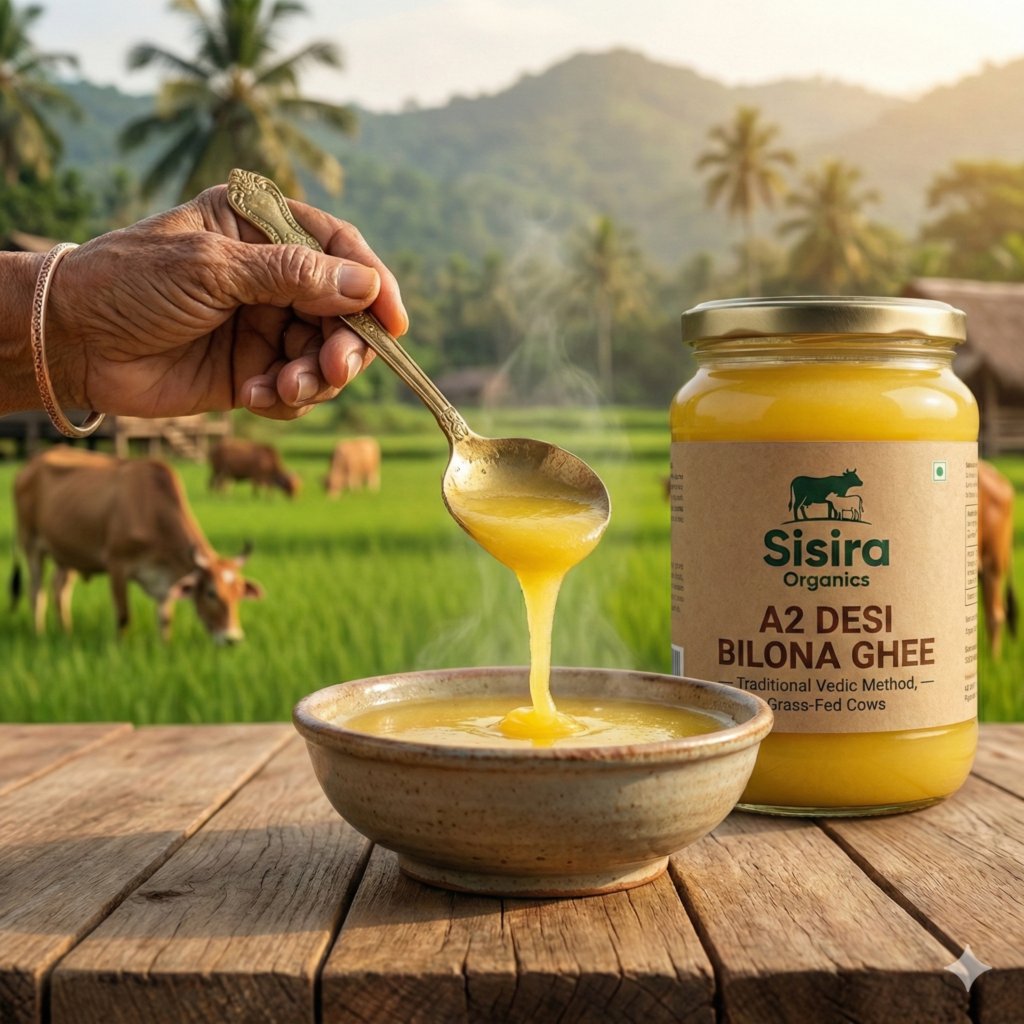
A2 Desi Bilona Ghee is the most traditional, most nutritionally complete, and most therapeutically valued form of clarified butter in Indian culinary and Ayurvedic heritage. It combines two specific attributes that together define its exceptional quality: the A2 milk from indigenous Indian cow breeds that naturally produce A2 beta-casein protein, and the Bilona method — the ancient Vedic process of fermenting milk into curd and slow-churning it to extract butter before low-flame clarification.
Neither attribute alone is sufficient. A2 milk processed industrially does not give you bilona ghee. Traditional bilona churning from A1 commercial milk does not give you A2 ghee. The combination of the right cow, the right milk, and the right process — that is what produces the golden, grainy, intensely aromatic fat that Ayurvedic texts have recommended for over 5,000 years and that modern nutritional science is now confirming is genuinely extraordinary.
This is the complete guide to A2 Desi Bilona Ghee — what it is, how it’s made, what the science says, why it is different from everything else in the market, and how to identify the real thing from the many impostors.
Table of Contents
- What is A2 Desi Bilona Ghee? — The Complete Definition
- A1 vs A2 Milk — The Protein That Changes Everything
- The 5-Step Vedic Bilona Process — Made Simple
- Bilona Ghee vs Commercial Ghee — Full Comparison
- 7 Science-Backed Health Benefits
- Nutritional Profile — What’s in Every Spoonful
- How to Use A2 Bilona Ghee in Daily Life
- How to Identify Genuine A2 Bilona Ghee
- What Ayurveda Says — 5,000 Years of Wisdom
- Frequently Asked Questions
What is A2 Desi Bilona Ghee? — The Complete Definition
A2 Desi Bilona Ghee is clarified butter produced exclusively from the milk of indigenous Indian cow breeds — Gir, Sahiwal, Red Sindhi, Tharparkar, Kankrej — using the traditional Vedic churning process called the bilona method. Every word in the name matters:
🐄
A2
Refers to the A2 beta-casein protein naturally present in the milk of indigenous desi cows. This specific protein structure makes the milk — and the ghee — easier to digest and more beneficial than A1 protein from crossbred cattle.
🏡
Desi
Refers to indigenous Indian cow breeds — Gir, Sahiwal, Red Sindhi, Tharparkar. These are the native cattle of the Indian subcontinent, genetically distinct from foreign breeds like Jersey or Holstein-Friesian imported for higher milk yield.
🪵
Bilona
Refers to the traditional wooden churner and the 5-step Vedic process it represents: milk → curd → churning → makkhan → slow clarification. Named after the wooden implement itself, which has been central to Indian dairy practice for millennia.
✨
Ghee
Pure clarified butter — all water, lactose, and milk solids have been removed during slow heating, leaving only the pure fat fraction with its concentrated nutrients, fat-soluble vitamins, and bioactive compounds.
The key distinction that matters: Most commercial ghee in India today — including expensive branded varieties — is made from cream directly separated from milk using industrial centrifuges, then boiled at high heat. This cream-based method bypasses the fermentation and churning steps entirely. It is fast, efficient, and scalable. It is not bilona ghee. The fermentation stage is what makes bilona ghee genuinely different — and the science of why is fascinating.
A1 vs A2 Milk — The Single Protein That Changes Everything
To understand why which cow the ghee comes from matters, you need to understand one of the most important and least-discussed developments in modern dairy science: the difference between A1 and A2 beta-casein protein.
Casein proteins make up approximately 80% of cow’s milk protein. The most abundant is beta-casein, which exists in two genetic variants: A1 and A2. The difference between them is a single amino acid at position 67 of the protein chain — histidine in A1 milk, and proline in A2 milk. This microscopic difference has significant consequences for how the protein is digested in the human body.
When A1 beta-casein is digested, the weak histidine bond at position 67 breaks, releasing a peptide called Beta-Casomorphin-7 (BCM-7). This opioid-like peptide has been associated in research with gut inflammation, digestive discomfort, and a range of immune responses in sensitive individuals. A2 milk’s proline bond does not break during digestion — BCM-7 is never released, and the digestive experience is fundamentally gentler.
What happened to India’s A2 cows? In the 1960s–70s, to meet rapidly growing milk demand, India imported semen from high-yield foreign bulls and crossbred millions of indigenous cows with Holstein-Friesian and Jersey cattle. These crossbred animals produce far more milk — but that milk carries A1 beta-casein. Today, much of the commercial dairy supply in India — including the cream used to make commercial ghee — comes from A1-producing crossbred cattle. Pure desi A2 cows are fewer in number and carefully maintained by farmers committed to native breed preservation. According to the FAO, several indigenous Indian cattle breeds are now classified as endangered or near-threatened.
The 5-Step Vedic Bilona Process — Why Every Step Matters
The bilona method is not simply a technique — it is a sequence of biological transformations that progressively enhance the nutritional quality of the final ghee at every step. Understanding why each step exists reveals why skipping even one of them produces a fundamentally inferior product.
Why 25–30 litres of milk per litre of ghee: Desi cows like Gir produce approximately 5–8 litres of milk per day — far less than crossbred cattle. Fermentation and churning yield approximately 4–5% butter from milk (vs 8–10% from cream separation). And slow clarification has a lower final yield than industrial processing. Combined, these factors mean 25–30 litres of pure A2 desi cow milk are required to produce just 1 litre of genuine bilona ghee — making it one of the most labour and resource-intensive food products in traditional Indian cuisine.
Bilona Ghee vs Commercial Ghee — The Difference Nobody Talks About
Most people assume that all ghee is essentially the same product — clarified butter varying only in brand and price. The reality is that commercial ghee and bilona ghee are made by completely different processes that produce nutritionally distinct outcomes:
7 Science-Backed Health Benefits of A2 Desi Bilona Ghee
The health benefits of A2 Desi Bilona Ghee are rooted in its unique biochemical composition — compounds that are either absent or significantly reduced in commercial ghee. Here are the 7 most important, each with the science behind it:
Gut Health — Butyric Acid is the Real Star
The most celebrated health benefit of A2 bilona ghee is its richness in butyric acid (butyrate) — a short-chain fatty acid that serves as the primary energy source for colonocytes, the cells lining your colon. Butyrate actively nourishes the intestinal lining, reduces intestinal inflammation, supports the gut microbiome, and helps maintain the integrity of the gut barrier — the defence against leaky gut syndrome. The Indian Journal of Dairy Science (2019) confirmed that bilona-method ghee contains 15–20% more butyric acid than cream-based ghee from identical milk. This is not incidental — the fermentation stage in bilona processing generates precursor compounds that convert into higher butyrate during clarification. No fermentation means less butyrate. It is that direct.
Heart Health — The CLA and Omega-3 Advantage
Conjugated Linoleic Acid (CLA) in ghee from grass-fed desi cows is significantly higher than in commercially produced alternatives. CLA has been associated in multiple studies with reduced body fat, improved HDL (good) cholesterol levels, and anti-tumour properties. Research shows that grass-fed cows produce milk with up to 500% more CLA than grain-fed confined cattle — making the sourcing model for A2 bilona ghee a direct health advantage. Combined with higher Omega-3 fatty acids from grass-fed desi cows, A2 bilona ghee supports a more balanced Omega-6 to Omega-3 ratio — a key factor in reducing systemic inflammation and cardiovascular risk.
Fat-Soluble Vitamin Delivery — A, D, E & K2
Ghee is one of the richest natural sources of fat-soluble vitamins A, D, E, and K2 — vitamins that cannot be absorbed without dietary fat present. A2 bilona ghee from grass-fed desi cows contains significantly more beta-carotene (converted to Vitamin A) than commercial ghee — visible in its characteristic deep golden colour. Vitamin K2, in particular, is scarce in most modern diets and is essential for directing calcium to bones rather than arteries — making ghee one of the few traditional foods that naturally protects against both osteoporosis and arterial calcification simultaneously.
Brain Function — MCTs for Mental Clarity
Ghee contains medium-chain triglycerides (MCTs) — fats that bypass the normal digestive pathway and are rapidly converted by the liver into ketones, providing immediate, clean fuel for the brain. Unlike glucose-derived energy, ketone fuel from MCTs does not cause blood sugar spikes. Ayurvedic practice has prescribed ghee for memory, focus, and mental clarity for thousands of years — and the MCT mechanism is now the biochemical explanation for these traditional observations. The Charaka Samhita specifically recommends ghee for enhancing Medhya (intellect) — a recommendation that neuroscience is slowly validating through research into ketone metabolism and brain function.
Immune Support — Antioxidants and Vitamin Synergy
A 2021 study in the Journal of Ayurveda and Integrative Medicine demonstrated that traditional bilona ghee shows superior antioxidant activity (measured by DPPH scavenging) compared to industrial ghee — attributed specifically to the preservation of phenolic compounds during the fermentation and low-heat clarification stages. These antioxidants, combined with Vitamins A, D, and E, collectively support T-cell immune function, protect cells from free radical damage, and reduce the inflammatory signalling that undermines immune response over time.
Bone Health — The Vitamin K2 Connection
Vitamin K2, found in meaningful quantities in grass-fed desi cow ghee, activates osteocalcin — the protein that binds calcium into bone matrix. Without Vitamin K2, calcium absorbed from diet may deposit in arteries and soft tissues rather than strengthening bones. This is why populations with high traditional dairy fat consumption from grass-fed animals historically showed strong bone density. A2 bilona ghee, sourced from free-grazing desi cows, is one of the most concentrated natural dietary sources of Vitamin K2 available in a traditional Indian diet.
Safe for High-Heat Indian Cooking — 250°C Smoke Point
A2 bilona ghee has one of the highest smoke points of any traditional cooking fat — approximately 250°C (482°F). This is significantly higher than most cold pressed oils (160–175°C) and far higher than butter (177°C). The high smoke point comes from ghee’s primarily saturated fat composition, which is inherently stable at high temperatures. When ghee is heated to cooking temperatures, it does not oxidise, does not form harmful aldehydes, and does not degrade into trans fats — making it one of the genuinely safest fats for all forms of Indian high-heat cooking, from tadka to deep frying.
Nutritional Profile — What’s in Every Spoonful of A2 Bilona Ghee
How to Use A2 Bilona Ghee in Daily Life — Beyond Just Cooking
One of the most underappreciated qualities of A2 desi bilona ghee is its versatility. In traditional Indian households it was never just a cooking fat — it was medicine, skincare, baby care, and a daily wellness ritual all in one pot.
🍳 Everyday Indian Cooking
Tadka for dal and sabzi, drizzled over hot rice and roti, in khichdi and kheer, as a finishing fat over parathas. The 250°C smoke point makes it safe for all heat levels including deep frying.
🌅 Morning Ritual
One teaspoon of A2 bilona ghee consumed on an empty stomach or stirred into warm water with a pinch of rock salt — an Ayurvedic practice believed to stimulate digestive fire (Agni) and lubricate the intestinal tract.
🧠 Brain Coffee / Golden Milk
A teaspoon stirred into morning coffee, chai, or golden milk (turmeric latte) adds MCTs for sustained cognitive energy, improves absorption of fat-soluble curcumin from turmeric, and creates a rich, satisfying flavour.
👶 Infant & Child Nutrition
Traditionally the first food added to a child’s diet at the annaprashana ceremony — a small amount stirred into the first rice. Ghee provides essential fatty acids for brain development, Vitamin A for vision, and healthy fats for rapid childhood growth.
💆 Skin & Hair Care
Applied topically, warm A2 bilona ghee deeply moisturises dry skin, soothes cracked heels, nourishes hair ends, and has traditionally been used for lip care and minor burns. Its Vitamin A and E content support skin cell regeneration.
🌿 Ayurvedic Nasya & Massage
In Ayurveda, two drops of warm ghee placed in each nostril (Nasya) lubricates nasal passages and supports sinus health. Full-body abhyanga massage with warm ghee is prescribed for calming Vata dosha, joint lubrication, and deep relaxation.
How to Identify Genuine A2 Desi Bilona Ghee — 6 Tests That Never Lie
The market for “A2 bilona ghee” is unfortunately full of products that carry the label but not the quality. With prices ranging from ₹500 to ₹3,000 per litre for products claiming the same name, here is how to tell the genuine article from the impostors:
🟡
Test 1: Colour — It Should Be Deeply Golden
Genuine A2 bilona ghee from grass-fed desi cows is a deep, warm golden-yellow colour — not pale yellow, not white, not transparent. The golden colour comes from high beta-carotene content in desi cow milk. Pale or colourless ghee almost certainly comes from crossbred cattle on grain-based feed, regardless of what the label says.
🌾
Test 2: Texture — Grainy, Not Smooth
Authentic bilona ghee processed at low heat develops a grainy or crystalline texture at room temperature — caused by the gradual crystallisation of specific triglycerides during slow cooling. Industrial ghee processed at high heat has a smooth, homogeneous texture. If your ghee looks like smooth, uniform solid — it was not made using the traditional low-heat bilona process.
👃
Test 3: Aroma — Rich, Nutty, Unmistakable
Open the container and smell it before tasting anything. Genuine A2 bilona ghee has a deeply rich, warm, toasted-dairy aroma — complex and immediately appetite-stimulating. Industrial ghee has a flatter, milder, or sometimes slightly artificial smell. The difference is unmistakable once you have experienced genuine bilona ghee.
✋
Test 4: The Palm Test — Melts at Body Temperature
Place a small amount of ghee on your palm. Pure A2 bilona ghee melts almost instantly at body temperature (37°C) — because its fatty acid composition is optimised by nature to melt precisely at human body temperature. Adulterated or industrial ghee may remain solid longer, feel waxy, or leave a greasy residue.
📋
Test 5: Label — Specify Breed + Method + Single Ingredient
Genuine A2 bilona ghee labels should specify: the cow breed (Gir, Sahiwal, Red Sindhi, Tharparkar — not just “desi cow”), the preparation method (bilona, vedic bilona, hand-churned), and the ingredient list should say only “pure cow ghee” — nothing else. FSSAI certification number should be present and verifiable.
💰
Test 6: Price — The Math of Authenticity
Genuine A2 desi bilona ghee requires 25–30 litres of indigenous cow milk per litre of ghee — at ₹50–80 per litre for quality A2 desi cow milk, the raw material alone costs ₹1,250–₹2,400 per litre of ghee, before any processing, labour, or packaging. Authentic A2 bilona ghee priced below ₹1,200–₹1,500 per litre is mathematically suspicious. It may be blended, from crossbred cattle, or produced via industrial shortcuts despite the “bilona” label.
What Ayurveda Says — 5,000 Years of Documented Wisdom
Ghee from desi cows made by traditional churning is perhaps the most consistently celebrated therapeutic food in the entire canon of Ayurvedic medicine — referenced across multiple classical texts with a specificity that suggests direct clinical observation over generations.
📜 Charaka Samhita
“Ghritam Jeeryati Jeevanti” — “Ghee is a rejuvenating elixir that enhances vitality and longevity.” The Charaka Samhita devotes entire chapters to ghee preparation and therapeutic application, prescribing it for Medhya (intellect), Agni (digestive fire), Ojas (vital energy), and Vata and Pitta dosha balance.
📜 Ashtanga Hridayam
This 7th-century Ayurvedic compendium describes ghee as “the best of all fats” and prescribes abhyanga (full-body warm oil massage) using ghee for nervous system calming, joint lubrication, and supporting Prana (life force). It specifically recommends ghee from desi cows for maximum therapeutic benefit.
🧘 Panchakarma Detox
A2 bilona ghee is central to Panchakarma — Ayurveda’s most comprehensive detoxification protocol. Medicated ghee is consumed in increasing doses over 3–7 days to carry toxins (Ama) from deep tissues into the digestive tract for elimination. The butyric acid in bilona ghee makes it uniquely effective at binding and facilitating this elimination.
The Ayurvedic insight that modern science is validating: Ancient Ayurvedic physicians observed that ghee from desi cows made by the bilona process was therapeutically superior to ghee made by other methods — millennia before the concepts of butyric acid, beta-carotene, CLA, or A1/A2 protein existed. The observation preceded the explanation by 5,000 years. Modern nutritional science is not discovering something new about A2 desi bilona ghee — it is explaining something that traditional Indian health wisdom always knew.
Frequently Asked Questions
What is A2 Desi Bilona Ghee?
A2 Desi Bilona Ghee is traditionally made clarified butter produced exclusively from the milk of indigenous Indian desi cow breeds — Gir, Sahiwal, Red Sindhi — using the ancient Vedic bilona method. The milk is fermented into curd, churned using a wooden bilona to extract makkhan (butter), and the butter is slowly clarified on a low flame. This 5-step process preserves butyric acid, CLA, Vitamins A, D, E, K2, and natural antioxidants that are significantly reduced in commercially produced ghee.
What is the difference between A2 bilona ghee and regular ghee?
Commercial ghee is made by separating cream directly from milk using industrial centrifuges and boiling it at high heat — bypassing the fermentation stage entirely. A2 bilona ghee ferments milk into curd first, then churns it using a traditional wooden bilona, then clarifies on low heat. The Indian Journal of Dairy Science (2019) confirmed bilona-method ghee contains 15–20% more butyric acid. Additionally, A2 bilona ghee uses only indigenous desi cows producing A2 beta-casein, while commercial ghee typically uses crossbred cattle producing A1 protein.
How many litres of milk are needed to make 1 litre of bilona ghee?
Approximately 25 to 30 litres of pure A2 milk from indigenous desi cows are required to produce 1 litre of genuine bilona ghee. Desi cow breeds produce lower milk volumes, the bilona churning process yields less butter per litre than cream separation, and slow clarification produces less final ghee than industrial processing. This yield combination is why authentic A2 desi bilona ghee is priced at ₹1,500–₹3,000 per litre.
Is A2 bilona ghee good for lactose intolerant people?
Yes — A2 desi bilona ghee is suitable for most lactose-intolerant individuals because the fermentation stage pre-digests lactose and the slow clarification process removes virtually all remaining milk solids (including lactose and casein). Additionally, the A2 beta-casein protein from desi cows does not release BCM-7 — the peptide linked to digestive discomfort from A1 milk. Most people with mild to moderate lactose intolerance can consume A2 bilona ghee without issue.
What is the smoke point of A2 bilona ghee?
A2 desi bilona ghee has a smoke point of approximately 250°C (482°F) — one of the highest of any cooking fat. This makes it suitable for all forms of Indian high-heat cooking including deep frying, sautéing, and tadka. At cooking temperatures, ghee’s primarily saturated fat composition remains chemically stable and does not form harmful oxidation products or trans fats.
How do I identify genuine A2 bilona ghee?
Look for: (1) Deep golden-yellow colour from beta-carotene; (2) Grainy, crystalline texture at room temperature; (3) Rich, nutty, toasted-dairy aroma; (4) Melts instantly on the palm at body temperature; (5) Label specifying cow breed (not just “desi cow”), bilona preparation method, and single-ingredient list; (6) FSSAI certification; (7) Realistic pricing of ₹1,500+ per litre — significantly cheaper products cannot be genuinely made by the bilona process with authentic A2 milk given the milk volume required.
How much A2 bilona ghee should I consume daily?
Ayurvedic tradition and modern nutritional guidance both suggest 1–2 teaspoons (5–10g) of A2 bilona ghee per day for a healthy adult as part of a balanced diet. This amount provides meaningful quantities of butyric acid, CLA, and fat-soluble vitamins without excessive caloric intake. Athletes, growing children, and those following specific Ayurvedic protocols may consume more, ideally with the guidance of a nutritionist or Ayurvedic practitioner.
Conclusion: Some Things Were Right the First Time
There is something quietly profound about A2 Desi Bilona Ghee. It is a food that was made correctly from the beginning — the right cow, the right process, the right intention. And then, over the course of a few decades of industrial food production, it was replaced by something faster, cheaper, and less. The pale, smooth, odourless commercial ghee that filled the supermarket shelves was not an improvement. It was a substitution — and a nutritional downgrade that millions of Indian families accepted without realising what they were trading away.
The return to A2 desi bilona ghee that is happening today is not nostalgia. It is recognition — backed by peer-reviewed science, Ayurvedic validation, and the simple test of taste and aroma — that the original was better. The butyric acid, the CLA, the deep golden beta-carotene, the grainy texture, the 250°C smoke point stability, the profound absence of BCM-7 — these are not marketing claims. They are the measurable outcomes of choosing the right cow and taking the time to make ghee the way it was always supposed to be made.
That brass pot in your grandmother’s kitchen was not a relic. It was a prescription — one that modern nutritional science is finally catching up to.
Coming Soon to Sisira Organics
We are bringing you authentic A2 Desi Bilona Ghee — sourced from indigenous desi cows, made by the traditional 5-step Vedic bilona method, with no shortcuts and no compromise. Paired with our complete range of wood pressed oils for the healthiest Indian kitchen possible.
✅ Wood Pressed Oils Available Now · ✅ A2 Ghee Coming Soon
Continue Reading